Large embedding jobs can outgrow the throughput of one model process before they exhaust the available CPU cores or GPUs. Sentence Transformers can distribute one encode() call across a device list while returning a single embedding matrix in the original input order.
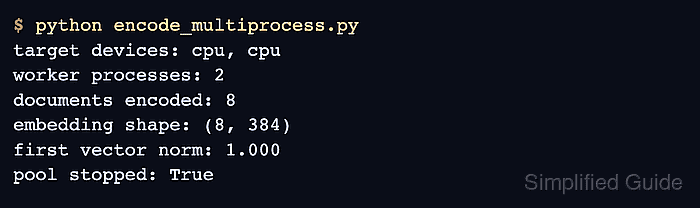
Repeated cpu entries create multiple CPU workers, while entries such as cuda:0 and cuda:1 assign one worker to each GPU. Passing the device list directly suits one large encode call because Sentence Transformers creates and stops the pool automatically; an explicitly reusable pool is more efficient when several calls share the same workers.
The chunk_size value controls how many texts are sent to each process, whereas batch_size controls the inference batches inside each process. Comparing the parallel matrix with a serial encode of the same ordered inputs detects missing, reordered, or changed vectors, and unit-length checks confirm that normalization was applied.
Steps to encode Sentence Transformers embeddings with multiple processes:
- Create the program's model, input, and worker-target section in encode_multiprocess.py.
- encode_multiprocess.py
import numpy as np
from sentence_transformers import SentenceTransformer


MODEL_ID = "sentence-transformers/all-MiniLM-L6-v2"
DOCUMENTS = [
    "Reset a forgotten password from the profile security page.",
    "Export paid invoices from the billing dashboard.",
    "Rotate API tokens before sharing an integration.",
    "Change the notification email address for alerts.",
    "Create a vector index for semantic document search.",
    "Archive old support tickets after the retention period.",
    "Review failed background jobs from the worker dashboard.",
    "Update the workspace theme for a user profile.",
]
TARGET_DEVICES = ["cpu", "cpu"]
- Append the multi-process encoder after the worker-target list.
def encode_parallel(model: SentenceTransformer) -> np.ndarray:
    return model.encode(
        DOCUMENTS,
        device=TARGET_DEVICES,
        batch_size=2,
        chunk_size=4,
        normalize_embeddings=True,
        show_progress_bar=False,
    )
One target per GPU is recommended for GPU hosts. Repeated cpu entries create separate CPU worker processes, and chunk_size can be increased for a much larger corpus when each worker has enough memory.
Related: How to select a Sentence Transformers inference device - Append the single-process baseline after encode_parallel().
def encode_serial(model: SentenceTransformer) -> np.ndarray:
    return model.encode(
        DOCUMENTS,
        device="cpu",
        batch_size=2,
        normalize_embeddings=True,
        show_progress_bar=False,
    )
- Append the verification entry point after encode_serial().
def main() -> None:
    model = SentenceTransformer(MODEL_ID)
    parallel_embeddings = encode_parallel(model)
    serial_embeddings = encode_serial(model)

    serial_match = np.allclose(parallel_embeddings, serial_embeddings, atol=1e-5)
    unit_lengths = np.allclose(
        np.linalg.norm(parallel_embeddings, axis=1),
        1.0,
        atol=1e-5,
    )

    print(f"worker targets: {len(TARGET_DEVICES)}")
    print(f"documents encoded: {len(DOCUMENTS)}")
    print(f"embedding shape: {parallel_embeddings.shape}")
    print(f"serial match: {serial_match}")
    print(f"unit lengths: {unit_lengths}")

    if not serial_match or not unit_lengths:
        raise RuntimeError("Multi-process encoding verification failed")


if __name__ == "__main__":
    main()
- Run the completed multi-process encoding program.
$ python encode_multiprocess.py
worker targets: 2
documents encoded: 8
embedding shape: (8, 384)
serial match: True
unit lengths: True
PyTorch shares model weights through system shared memory. A container with a small /dev/shm allocation can fail with No space left on device before workers start; a larger shared-memory allocation or fewer worker targets is required in that environment.

Mohd Shakir Zakaria is a cloud architect with deep roots in software development and open-source advocacy. Certified in AWS, Red Hat, VMware, ITIL, and Linux, he specializes in designing and managing robust cloud and on-premises infrastructures.


