PHP applications that share the default session directory can leave unrelated sess_* files under one system path, which complicates ownership, cleanup, and pool isolation. Setting a dedicated session save path keeps file-backed session data under the application or PHP-FPM pool that owns it instead of mixing it into a general temporary directory.
When session.save_handler is files, PHP passes session.save_path to the file storage handler and writes one sess_* file for each active session. The effective value can come from the main php.ini file, scanned .ini fragments, PHP-FPM pool directives, web-server FastCGI overrides, per-directory .user.ini files, or application code, so the final check has to come from the same web-facing runtime that serves the site.
The new path also needs ownership and permissions that match the runtime user, and session expiry needs a cleanup path that still reaches the new directory. Some hosts run garbage collection during requests while others rely on an OS-level timer or cron job, so a pool-specific override may need matching cleanup logic. Separate directories are also safer when different pools or applications use different owners or session.gc_maxlifetime values.
Related: How to set PHP open_basedir for a PHP-FPM pool
Related: How to create a PHP-FPM pool
Steps to set the PHP session save path:
- Identify the loaded PHP-FPM php.ini file and confirm that the runtime still uses the file-backed session handler.
$ php-fpm8.5 -i | grep -E 'Loaded Configuration File|^(session.gc_probability|session.save_handler|session.save_path) =>'
Loaded Configuration File => /etc/php/8.5/fpm/php.ini
session.gc_probability => 0 => 0
session.save_handler => files => files
session.save_path => /var/lib/php/sessions => /var/lib/php/sessions
Use php-fpm instead of php-fpm8.5 when the local binary is not versioned. The php --ri session and php --ini commands only report the CLI SAPI, which can differ from the runtime that serves web requests. If session.gc_probability is 0, old sessions may be cleaned by a distro timer or cron job instead of request-time garbage collection.
If the handler is already redis, memcached, or another non-files backend, changing session.save_path will not move the active session store.
Related: How to find PHP configuration files
- Search PHP-FPM pool files for session overrides before changing the global php.ini value.
$ sudo grep -REn 'php_(admin_)?value\[(session.save_path|session.save_handler|session.gc_maxlifetime)\]' /etc/php/8.5/fpm/pool.d
No output means the pool files are not overriding these directives. If a pool file already sets session.save_path, update that pool instead of assuming the global php.ini controls the site. When the host relies on a timer or cron job for old-session cleanup, confirm that job follows the new directory if the path is changed only in a pool override.
- Back up the active php.ini file before editing it.
$ sudo cp /etc/php/8.5/fpm/php.ini /etc/php/8.5/fpm/php.ini.bak-$(date +%Y%m%d%H%M%S)
- Create a dedicated session directory with ownership and permissions that match the runtime user.
$ sudo install -d -m 700 -o www-data -g www-data /var/lib/php/app-session
$ ls -ld /var/lib/php/app-session
drwx------ 2 www-data www-data 4096 Jun  6 01:55 /var/lib/php/app-session
Avoid broad locations such as /tmp on multi-user hosts because another local account could read or replace session files there.
Use a separate directory per pool or application when owners, group permissions, or session.gc_maxlifetime differ.
- Open the active php.ini file and set session.save_path to the dedicated directory.
$ sudoedit /etc/php/8.5/fpm/php.ini
session.save_path = "/var/lib/php/app-session"
Keep the setting in the FPM php.ini or a scanned conf.d file when the host cleanup routine needs to discover the custom path automatically. Use a pool override only when the change must stay pool-specific.
The optional N;MODE;/path format changes directory depth and file mode. Keep the value quoted when semicolons are present, and remember that automatic garbage collection does not run when N is greater than 0.
- Test the PHP-FPM configuration before reloading the service.
$ sudo php-fpm8.5 -t
[06-Jun-2026 01:55:21] NOTICE: configuration file /etc/php/8.5/fpm/php-fpm.conf test is successful
Do not reload the service until the configuration test succeeds.
- Reload the runtime that serves the application so new workers read the updated directive.
$ sudo systemctl reload php8.5-fpm
Use the matching unit name for the installed package, such as php-fpm on many Fedora, Red Hat, or CentOS Stream hosts. Reload Apache instead when PHP runs as an Apache module, and skip the service reload entirely for a CLI-only change.
- Create a temporary probe script in the document root served by the edited runtime.
$ sudo tee /var/www/example.com/public/session-path-check.php >/dev/null <<'PHP'
<?php
session_start();
header('Content-Type: text/plain');
echo session_save_path(), PHP_EOL;
PHP
Replace /var/www/example.com/public with the document root for the site that uses this pool. Using a web request for the final check confirms the same SAPI, pool, and FastCGI overrides that serve live traffic.
Remove the probe file after verification so session configuration details are not left exposed over HTTP.
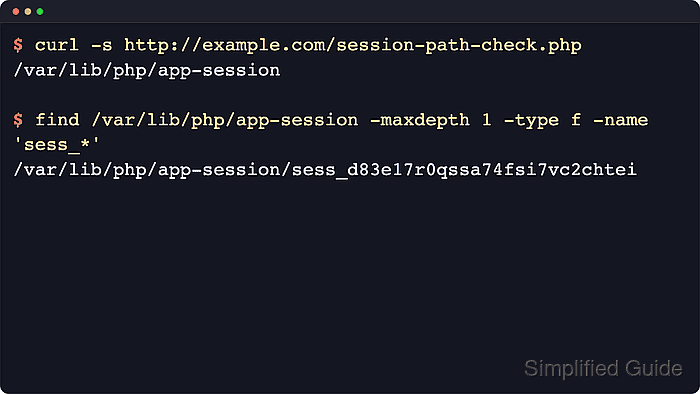
- Request the probe script and confirm that it reports the new directory.
$ curl -s http://example.com/session-path-check.php
/var/lib/php/app-session
If the returned path is still the old value, check for a pool override, a web-server PHP_VALUE or PHP_ADMIN_VALUE directive, a .user.ini entry, or application code that calls session_save_path() or ini_set() before session_start().
- Confirm that a sess_* file was created in the new directory.
$ find /var/lib/php/app-session -maxdepth 1 -type f -name 'sess_*'
/var/lib/php/app-session/sess_a09356a37d4b563c09374231a93ba40f
- Remove the temporary probe file after the check succeeds.
$ sudo rm /var/www/example.com/public/session-path-check.php

Mohd Shakir Zakaria is a cloud architect with deep roots in software development and open-source advocacy. Certified in AWS, Red Hat, VMware, ITIL, and Linux, he specializes in designing and managing robust cloud and on-premises infrastructures.


