How to train, evaluate, and run prediction with a Keras model
Most Keras projects pass data through the same lifecycle before the model is ready for larger datasets or deployment code. A compiled model trains with fit(), checks held-out data with evaluate(), and returns inference arrays with predict().
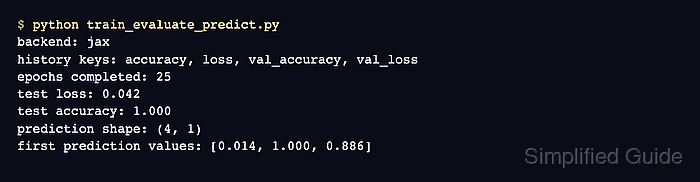
The script uses the standalone Keras package with the JAX backend and small NumPy arrays. That keeps the focus on the built-in model methods instead of dataset pipeline construction, checkpointing, or saved-model loading.
The same sequence still applies after changing the model architecture, loss function, or input source. fit() returns a History object, evaluate() can return a metric dictionary, and predict() returns batched NumPy arrays whose first dimension matches the requested samples.
Steps to train, evaluate, and run prediction with a Keras model:
- Create train_evaluate_predict.py with backend selection, imports, and held-out arrays.
- train_evaluate_predict.py
import os

os.environ["KERAS_BACKEND"] = "jax"

import keras
import numpy as np

keras.utils.set_random_seed(7)

rng = np.random.default_rng(7)
x_train = rng.uniform(size=(64, 2)).astype("float32")
y_train = (x_train[:, 0] > x_train[:, 1]).astype("float32")

x_test = rng.uniform(size=(16, 2)).astype("float32")
y_test = (x_test[:, 0] > x_test[:, 1]).astype("float32")
The KERAS_BACKEND value must be set before import keras. Use tensorflow or torch only when that backend is installed in the same environment.
Related: How to install Keras with pip
Related: How to set the Keras backend - Add the model definition after the arrays.
model = keras.Sequential(
    [
        keras.layers.Input(shape=(2,)),
        keras.layers.Dense(8, activation="relu"),
        keras.layers.Dense(1, activation="sigmoid"),
    ]
)
- Compile the model with an optimizer, loss, and metric.
model.compile(
    optimizer=keras.optimizers.Adam(learning_rate=0.05),
    loss=keras.losses.BinaryCrossentropy(),
    metrics=[keras.metrics.BinaryAccuracy(name="accuracy")],
)
BinaryAccuracy matches the single sigmoid output and binary target array used in the script.
Related: How to compile a model in Keras - Add fit() with held-out validation data.
history = model.fit(
    x_train,
    y_train,
    validation_data=(x_test, y_test),
    epochs=25,
    batch_size=8,
    verbose=0,
)
validation_data records val_loss and val_accuracy in the returned History object without changing the training arrays.
- Add evaluate(), predict(), and output lines after training.
results = model.evaluate(x_test, y_test, verbose=0, return_dict=True)
predictions = model.predict(x_test[:4], verbose=0)

print(f"backend: {keras.backend.backend()}")
print("history keys:", ", ".join(sorted(history.history.keys())))
print(f"epochs completed: {len(history.history['loss'])}")
print(f"test loss: {results['loss']:.3f}")
print(f"test accuracy: {results['accuracy']:.3f}")
print(f"prediction shape: {predictions.shape}")
rounded = ", ".join(f"{value:.3f}" for value in predictions[:3, 0])
print(f"first prediction values: [{rounded}]")
return_dict=True names the evaluation outputs, which avoids relying on metric order when reading the result.
- Run the script and confirm that training, evaluation, and prediction all return output.
$ python train_evaluate_predict.py
backend: jax
history keys: accuracy, loss, val_accuracy, val_loss
epochs completed: 25
test loss: 0.042
test accuracy: 1.000
prediction shape: (4, 1)
first prediction values: [0.014, 1.000, 0.886]