Many statistical questions reduce to an area under a model: the chance of observing a value below a limit, above a limit, or inside a range. A parameterized SciPy distribution calculates those areas without evaluating or integrating the density by hand.
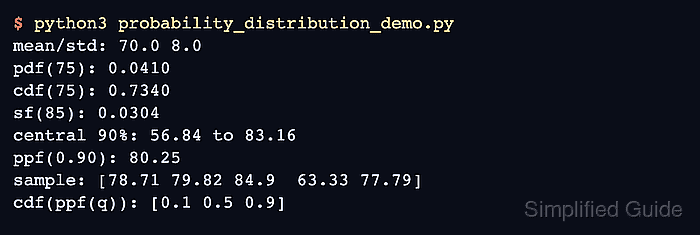
A frozen scipy.stats.norm object stores a mean of 70 and a standard deviation of 8. Its cdf() method returns lower-tail probability, sf() returns upper-tail probability, and the difference between two cumulative values gives the probability inside an interval.
The ppf() method moves in the opposite direction by converting a cumulative probability into a cutoff. For a continuous distribution, pdf() is density rather than probability at one exact value, so threshold and interval questions belong to the cumulative methods.
Steps to calculate probabilities with SciPy distributions:
- Create probability_distribution.py with the imports and frozen normal distribution.
- probability_distribution.py
import numpy as np
from scipy.stats import norm

scores = norm(loc=70, scale=8)
loc sets the normal distribution's mean, and scale sets its standard deviation. Freezing them once keeps every later calculation on the same model.
- Add lower-tail and upper-tail probability calculations below the distribution.
below_75 = scores.cdf(75)
above_85 = scores.sf(85)
sf() evaluates the upper tail directly and can be more accurate than subtracting cdf() from 1 when the cumulative probability is close to 1.
- Add the probability between scores 65 and 80 below the tail calculations.
between_65_and_80 = scores.cdf(80) - scores.cdf(65)
For a continuous distribution, subtracting the cumulative probability at the lower boundary from the cumulative probability at the upper boundary gives the area inside the interval.
- Add the 90th-percentile cutoff below the interval calculation.
percentile_90 = scores.ppf(0.90)
ppf(0.90) returns the score with 90 percent of the distribution at or below it.
- Add a cumulative round-trip assertion below the percentile calculation.
probability_levels = np.array([0.1, 0.5, 0.9])
round_trip = scores.cdf(scores.ppf(probability_levels))
np.testing.assert_allclose(round_trip, probability_levels, atol=1e-12)
The assertion raises an error if converting the probability levels to cutoffs and back does not recover the original values within floating-point tolerance.
- Append the calculated probabilities and cutoff below the assertion.
print(f"P(X <= 75): {below_75:.4f}")
print(f"P(X > 85): {above_85:.4f}")
print(f"P(65 < X <= 80): {between_65_and_80:.4f}")
print(f"90th percentile: {percentile_90:.2f}")
print("CDF round trip:", np.round(round_trip, 1))
- Run the completed probability calculation to verify the cumulative round trip.
$ python3 probability_distribution.py
P(X <= 75): 0.7340
P(X > 85): 0.0304
P(65 < X <= 80): 0.6284
90th percentile: 80.25
CDF round trip: [0.1 0.5 0.9]
The command exits before printing the results if the cumulative and inverse-cumulative round trip fails.

Mohd Shakir Zakaria is a cloud architect with deep roots in software development and open-source advocacy. Certified in AWS, Red Hat, VMware, ITIL, and Linux, he specializes in designing and managing robust cloud and on-premises infrastructures.


