A point estimate reduces a sample to one number, but it does not show how that estimate could vary across repeated samples. scipy.stats.bootstrap() resamples observed values with replacement and returns confidence bounds for a statistic without requiring a normal-distribution formula.
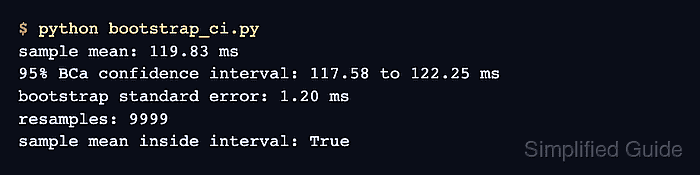
For a one-sample mean, bootstrap() still expects the data as a one-item tuple such as (latency_ms,). Giving the statistic an axis parameter lets SciPy process batches of resamples, while a fixed numpy.random.Generator makes the simulated distribution reproducible.
The bias-corrected and accelerated method, abbreviated BCa, adjusts the interval limits for bias and skewness. A degenerate statistic can make BCa bounds nan, so the program checks for finite ordered bounds, a finite standard error, and the requested resample count before reporting success.
Steps to compute a bootstrap confidence interval with SciPy:
- Create the initial bootstrap_ci.py file with the sample and repeatable random-number generator.
- bootstrap_ci.py
import numpy as np
from scipy.stats import bootstrap

latency_ms = np.array([
    117, 121, 113, 125,
    119, 128, 115, 122,
    120, 118, 124, 116,
])
rng = np.random.default_rng(20260625)
- Append the vectorized mean statistic to bootstrap_ci.py.
def mean_latency(sample, axis):
    return np.mean(sample, axis=axis)
- Append the BCa resampling call below mean_latency().
result = bootstrap(
    (latency_ms,),
    mean_latency,
    confidence_level=0.95,
    n_resamples=9999,
    method="BCa",
    rng=rng,
)
- Complete bootstrap_ci.py with the final result-handling section.
- bootstrap_ci.py
import numpy as np
from scipy.stats import bootstrap

latency_ms = np.array([
    117, 121, 113, 125,
    119, 128, 115, 122,
    120, 118, 124, 116,
])
rng = np.random.default_rng(20260625)


def mean_latency(sample, axis):
    return np.mean(sample, axis=axis)


result = bootstrap(
    (latency_ms,),
    mean_latency,
    confidence_level=0.95,
    n_resamples=9999,
    method="BCa",
    rng=rng,
)

interval = result.confidence_interval
sample_mean = np.mean(latency_ms)
checks_passed = (
    np.isfinite([interval.low, interval.high]).all()
    and np.isfinite(result.standard_error)
    and interval.low < interval.high
    and result.bootstrap_distribution.shape[-1] == 9999
)

if not checks_passed:
    raise RuntimeError("bootstrap result failed validation")

print(f"sample mean: {sample_mean:.2f} ms")
print(f"95% BCa interval: {interval.low:.2f} to {interval.high:.2f} ms")
print(f"bootstrap standard error: {result.standard_error:.2f} ms")
print(f"resamples: {result.bootstrap_distribution.shape[-1]}")
print("validation checks: passed")
BCa can return nan bounds when identical observations or a statistic that does not vary produce a degenerate bootstrap distribution.
- Confirm the confidence interval by running bootstrap_ci.py.
$ python3 bootstrap_ci.py
sample mean: 119.83 ms
95% BCa interval: 117.58 to 122.25 ms
bootstrap standard error: 1.20 ms
resamples: 9999
validation checks: passed

Mohd Shakir Zakaria is a cloud architect with deep roots in software development and open-source advocacy. Certified in AWS, Red Hat, VMware, ITIL, and Linux, he specializes in designing and managing robust cloud and on-premises infrastructures.


