Configuring PHP error logging keeps warnings, notices, and fatal failures available for troubleshooting without sending stack traces, internal paths, or query fragments back to the client. A dedicated script-error log also separates application diagnostics from web-server access logs and the PHP-FPM master log, which makes production failures easier to triage.
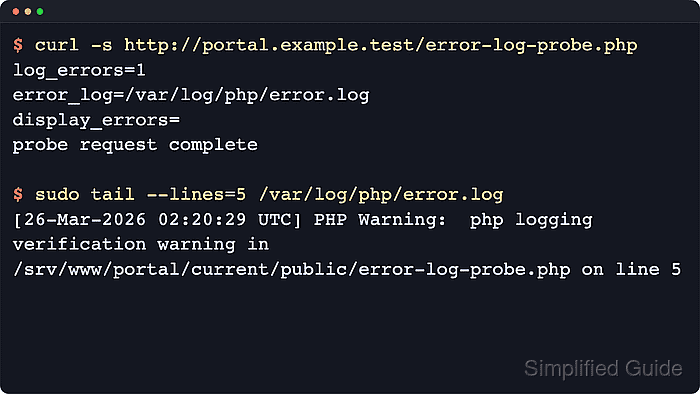
PHP writes script diagnostics only when log_errors is enabled, and the error_log directive decides whether those events go to a file or to syslog. On PHP-FPM hosts, the effective values can still be overridden later by pool-level php_value[] or php_admin_value[] directives, or by FastCGI PHP_VALUE and PHP_ADMIN_VALUE headers from the web server, so the active request path has to be checked before assuming one php.ini file controls everything.
Examples use the packaged PHP-FPM layout common on Ubuntu or Debian hosts, where web requests use a versioned binary such as php-fpm8.5 and a matching file such as /etc/php/8.5/fpm/php.ini. Substitute the branch installed on the target host, keep display_errors = Off on internet-facing applications, create a log path writable by the pool user, and reload the matching PHP-FPM service only after the configuration test succeeds.
Steps to configure PHP error logging:
- Check which PHP-FPM php.ini file is loaded for the runtime that serves the site.
$ php-fpm8.5 -i | grep 'Loaded Configuration File'
Loaded Configuration File => /etc/php/8.5/fpm/php.ini
Use php-fpm instead of php-fpm8.5 when the local binary is not versioned. php --ini reports the CLI configuration only, which can differ from the file used by PHP-FPM.
Related: How to find PHP configuration files
- Search the active PHP-FPM pool files for logging directives that can override the error-log settings from php.ini.
$ sudo grep -R "error_log\|log_errors\|display_errors" /etc/php/8.5/fpm/pool.d
/etc/php/8.5/fpm/pool.d/www.conf:;php_flag[display_errors] = off
/etc/php/8.5/fpm/pool.d/www.conf:;php_admin_value[error_log] = /var/log/fpm-php.www.log
/etc/php/8.5/fpm/pool.d/www.conf:;php_admin_flag[log_errors] = on
Lines beginning with ; are examples or comments. If an uncommented php_value[], php_admin_value[], php_flag[], or php_admin_flag[] line appears for one of these settings, adjust that pool setting or keep it intentionally because it can override the php.ini value for requests served by the pool. Web-server FastCGI PHP_VALUE or PHP_ADMIN_VALUE headers can still override the request path later, so check those as well if the final probe does not match the edited values.
- Back up the active php.ini file before editing it.
$ sudo cp /etc/php/8.5/fpm/php.ini /etc/php/8.5/fpm/php.ini.bak-$(date +%Y%m%d%H%M%S)
- Open the active PHP-FPM php.ini file in a text editor.
$ sudo vi /etc/php/8.5/fpm/php.ini
Replace the sample path with the file reported in the first step when the host uses a different PHP branch or packaging layout.
- Set the logging directives so PHP writes script errors to a dedicated file.
log_errors = On
error_log = /var/log/php/error.log
error_log_mode = 0640
display_errors = Off
The PHP manual documents error_log_mode as available from PHP 8.2 onward. On older runtimes, omit that line and create the file with the required mode ahead of time.
Set error_log = syslog instead of a file path when the host forwards PHP diagnostics to the system logger or a centralized collector.
Add error_reporting = E_ALL when notices and deprecations should be logged as well as warnings and fatal errors.
Keeping display_errors = On on an internet-facing application can leak internal paths, queries, and stack details to clients.
- Create the log directory and log file with ownership that matches the PHP-FPM pool user.
$ sudo install -d -o root -g www-data -m 0755 /var/log/php
$ sudo install -o www-data -g www-data -m 0640 /dev/null /var/log/php/error.log
Replace www-data if the pool uses a different user or group in the matching file under /etc/php/8.5/fpm/pool.d/.
- Run a PHP-FPM configuration test before reloading the service.
$ sudo php-fpm8.5 -t
[05-Jun-2026 21:32:30] NOTICE: configuration file /etc/php/8.5/fpm/php-fpm.conf test is successful
Some distributions expose the generic binary name php-fpm instead of a versioned binary. Use php-fpm -tt only when a resolved dump of global and pool settings is needed.
Do not reload the service until the configuration test succeeds.
- Reload PHP-FPM so the new logging directives apply to new requests.
$ sudo systemctl reload php8.5-fpm
On Fedora, Red Hat, or CentOS, the service unit is commonly php-fpm.
- Create a temporary probe script inside the document root served by the edited PHP-FPM pool.
$ sudo tee /var/www/html/error-log-probe.php >/dev/null <<'PHP'
<?php
printf("log_errors=%s\n", ini_get("log_errors"));
printf("error_log=%s\n", ini_get("error_log"));
printf("display_errors=%s\n", ini_get("display_errors"));
trigger_error('php logging verification warning', E_USER_WARNING);
echo "probe request complete", PHP_EOL;
PHP
Replace /var/www/html with the real document root for the site that uses this pool. Using a served probe confirms the same PHP-FPM pool and web-server override layers that handle live traffic.
Remove the probe file after the log entry is confirmed so a diagnostic endpoint is not left exposed.
- Request the probe file through the same host and path that reach the edited pool.
$ curl -s http://portal.example.test/error-log-probe.php
log_errors=1
error_log=/var/log/php/error.log
display_errors=
probe request complete
If the application is only reachable through HTTPS, a local vhost name, or an internal reverse proxy, use that exact URL instead of the masked example URL.
An empty display_errors value or 0 both mean the directive is disabled for that request. If the output still shows an old error_log path or log_errors state, re-check pool and web-server overrides before assuming the php.ini edit failed.
- Inspect the configured log file for the matching warning entry.
$ sudo cat /var/log/php/error.log
##### snipped
[05-Jun-2026 21:32:30 UTC] PHP Warning:  php logging verification warning in /var/www/html/error-log-probe.php on line 5
The timestamp, document root, and line number vary, but the warning text and probe path should match the temporary script.
- Remove the temporary probe file after the log entry is confirmed.
$ sudo rm /var/www/html/error-log-probe.php

Mohd Shakir Zakaria is a cloud architect with deep roots in software development and open-source advocacy. Certified in AWS, Red Hat, VMware, ITIL, and Linux, he specializes in designing and managing robust cloud and on-premises infrastructures.


