Retrieval-augmented generation separates source matching from the language model that writes an answer. In LlamaIndex, creating a retriever directly from an index lets an application inspect the selected nodes and their metadata without adding response synthesis.
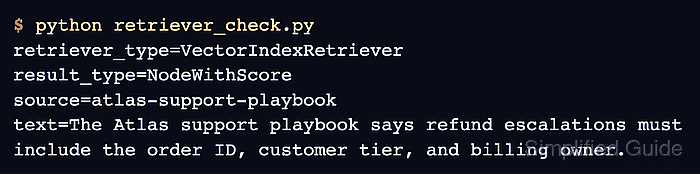
The index.as_retriever() method returns a retriever backed by that index. Calling retrieve() produces NodeWithScore objects, which carry each matched node, its metadata, and its similarity score when the backing store supplies one.
A local MockEmbedding keeps the check independent of API keys, but its fixed vectors make this a wiring test rather than a ranking evaluation. Use the application's embedding model when comparing relevance across multiple documents.
Steps to create a LlamaIndex retriever:
- Activate the .venv Python environment that contains llama-index-core.
$ source .venv/bin/activate
Related: How to install LlamaIndex with pip
- Start retriever_check.py with the retriever dependencies.
- retriever_check.py
from llama_index.core import Document, MockEmbedding, VectorStoreIndex
from llama_index.core.schema import NodeWithScore
- Add the local document fixture after the import block.
- retriever_check.py
documents = [
    Document(
        text=(
            "The Atlas support playbook says refund escalations must include "
            "the order ID, customer tier, and billing owner."
        ),
        metadata={"source": "atlas-support-playbook"},
    )
]
The single document isolates the index-to-retriever handoff from multi-document ranking behavior.
- Build the vector index after the document fixture.
- retriever_check.py
index = VectorStoreIndex.from_documents(
    documents,
    embed_model=MockEmbedding(embed_dim=8),
)
The mock embedding keeps index construction local and requires no API key.
Related: How to set an embedding model in LlamaIndex - Create the retriever after the index definition.
- retriever_check.py
retriever = index.as_retriever(similarity_top_k=1)
The similarity_top_k value limits retrieval to one node.
Related: How to set retriever similarity top K in LlamaIndex - Retrieve the matching node after the retriever definition.
- retriever_check.py
results = retriever.retrieve("What must a refund escalation include?")
first = results[0]
- Add fail-capable outcome checks after the retrieval block.
- retriever_check.py
assert len(results) == 1
assert isinstance(first, NodeWithScore)
assert first.node.metadata["source"] == "atlas-support-playbook"
assert "order ID, customer tier, and billing owner" in first.node.get_content()
- Print the retriever and matched node fields after the assertions.
- retriever_check.py
print(f"retriever_type={type(retriever).__name__}")
print(f"result_type={type(first).__name__}")
print(f"source={first.node.metadata['source']}")
print(f"text={first.node.get_content()}")
- Run the completed retriever script.
$ python retriever_check.py
retriever_type=VectorIndexRetriever
result_type=NodeWithScore
source=atlas-support-playbook
text=The Atlas support playbook says refund escalations must include the order ID, customer tier, and billing owner.

Mohd Shakir Zakaria is a cloud architect with deep roots in software development and open-source advocacy. Certified in AWS, Red Hat, VMware, ITIL, and Linux, he specializes in designing and managing robust cloud and on-premises infrastructures.


