Semantic retrieval depends on an index that keeps source text, metadata, and embeddings aligned before any answer-generation layer is added. A VectorStoreIndex provides that boundary in LlamaIndex by turning Document objects into embedded nodes that a retriever can search.
The direct build path uses VectorStoreIndex.from_documents(). LlamaIndex applies its configured transformations, embeds the resulting nodes, and stores them in an in-memory vector store unless a different StorageContext is supplied.
The deterministic BaseEmbedding subclass maps eight support-domain terms to vector positions, keeping the first construction check independent of hosted services. Its narrow vocabulary is not a production embedding model; indexing and retrieval in the application must share the same real model.
Steps to build a LlamaIndex VectorStoreIndex:
- Create vector_store_index_build.py with a deterministic embedding class for the local smoke test.
- vector_store_index_build.py
from llama_index.core import Document, VectorStoreIndex
from llama_index.core.embeddings import BaseEmbedding


class SupportKeywordEmbedding(BaseEmbedding):
    @classmethod
    def class_name(cls) -> str:
        return "SupportKeywordEmbedding"

    def _vector(self, text: str) -> list[float]:
        terms = [
            "billing",
            "refund",
            "escalation",
            "support",
            "inventory",
            "warehouse",
            "restart",
            "sync",
        ]
        lowered = text.lower()
        return [1.0 if term in lowered else 0.0 for term in terms]

    def _get_text_embedding(self, text: str) -> list[float]:
        return self._vector(text)

    def _get_query_embedding(self, query: str) -> list[float]:
        return self._vector(query)

    async def _aget_query_embedding(self, query: str) -> list[float]:
        return self._vector(query)
The embedding maps support and inventory terms to separate vector positions. Production indexing and retrieval must use the same application embedding model.
- Add two source documents after the embedding class.
documents = [
    Document(
        text=(
            "Billing support runbook: refund ticket 7421 belongs to Maya. "
            "Escalate refund questions to the docs-review queue."
        ),
        metadata={"source": "billing-support-runbook"},
    ),
    Document(
        text=(
            "Inventory runbook: warehouse sync ticket 8804 belongs to Arun. "
            "Restart the sync worker before opening an incident."
        ),
        metadata={"source": "inventory-runbook"},
    ),
]
Metadata remains attached to the nodes created from each document, so retrieved results can identify their source.
Related: How to load local files with SimpleDirectoryReader in LlamaIndex - Construct the in-memory VectorStoreIndex after the document list.
embed_model = SupportKeywordEmbedding()
index = VectorStoreIndex.from_documents(
    documents,
    embed_model=embed_model,
    insert_batch_size=2,
)
insert_batch_size=2 makes the two-document smoke-test batch explicit. Larger values favor local throughput, while smaller values reduce the request size sent to a remote vector store.
Related: How to persist and load an index in LlamaIndex - Add a retrieval check after the index construction block.
retriever = index.as_retriever(similarity_top_k=1)
nodes = retriever.retrieve("Which runbook covers refund escalation?")

print(f"index_type={type(index).__name__}")
print(f"indexed_ref_docs={len(index.ref_doc_info)}")
print(f"retriever_results={len(nodes)}")
print(f"top_source={nodes[0].node.metadata['source']}")
Checking retrieval proves that the built index can compare a query embedding with its stored document embeddings.
Related: How to create a retriever in LlamaIndex
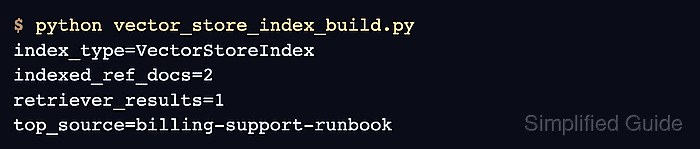
Related: How to run a query engine in LlamaIndex - Run the completed script from its directory.
$ python vector_store_index_build.py
index_type=VectorStoreIndex
indexed_ref_docs=2
retriever_results=1
top_source=billing-support-runbook
indexed_ref_docs=2 confirms that both source documents reached the index. top_source=billing-support-runbook confirms that retrieval selected the source containing the refund escalation terms.

Mohd Shakir Zakaria is a cloud architect with deep roots in software development and open-source advocacy. Certified in AWS, Red Hat, VMware, ITIL, and Linux, he specializes in designing and managing robust cloud and on-premises infrastructures.


