A trained network often needs to hand its learned parameters to a fresh process without carrying the optimizer or model configuration. A weights-only artifact keeps that handoff small while leaving architecture construction under application code.
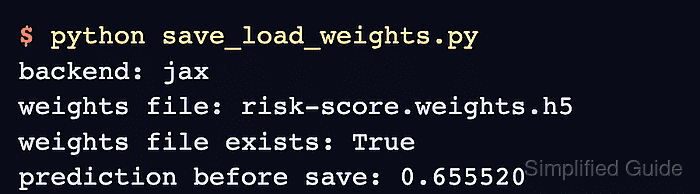
In Keras 3, model.save_weights() writes a single file whose name ends in .weights.h5 by default. load_weights() restores values according to the network topology, so the receiving model must create compatible weighted layers in the same order and with the same shapes.
A fixed two-feature weight fixture makes the round trip deterministic without depending on training noise. The receiving model comes from the same factory, and a fail-capable NumPy assertion compares its prediction with the source model's prediction after restoration.
Related: How to save and load a Keras model
Related: How to use ModelCheckpoint in Keras
Related: How to run transfer learning in Keras
Steps to save and load Keras model weights:
- Create weights_roundtrip.py with the JAX backend selection and reusable model factory.
- weights_roundtrip.py
import os

os.environ.setdefault("KERAS_BACKEND", "jax")

from pathlib import Path

import keras
import numpy as np


def build_model():
    return keras.Sequential(
        [
            keras.Input(
                shape=(2,),
                name="features",
            ),
            keras.layers.Dense(
                1,
                name="score",
            ),
        ]
    )
- Append the source-weight persistence block below build_model().
- weights_roundtrip.py
weights_path = Path("score.weights.h5")
sample = np.array(
    [[2.0, 4.0]],
    dtype="float32",
)
source_model = build_model()
source_model.layers[0].set_weights(
    [
        np.array(
            [[0.25], [0.75]],
            dtype="float32",
        ),
        np.array([-0.1], dtype="float32"),
    ]
)
prediction_before = np.asarray(
    source_model(sample, training=False)
)
source_model.save_weights(weights_path)
The .weights.h5 suffix selects the single-file weights format. The receiving model requires the same layer order and tensor shapes.
- Add the restore and prediction comparison below save_weights().
- weights_roundtrip.py
restored_model = build_model()
restored_model.load_weights(weights_path)
prediction_after = np.asarray(
    restored_model(sample, training=False)
)
np.testing.assert_allclose(
    prediction_before,
    prediction_after,
    atol=1e-7,
)

print(f"weights file: {weights_path}")
print(
    "prediction before save: "
    f"{prediction_before[0, 0]:.6f}"
)
print(
    "prediction after load: "
    f"{prediction_after[0, 0]:.6f}"
)
print("predictions match: True")
- Inspect the assembled weights_roundtrip.py file for the three constructed sections.
- weights_roundtrip.py
import os

os.environ.setdefault("KERAS_BACKEND", "jax")

from pathlib import Path

import keras
import numpy as np


def build_model():
    return keras.Sequential(
        [
            keras.Input(
                shape=(2,),
                name="features",
            ),
            keras.layers.Dense(
                1,
                name="score",
            ),
        ]
    )


weights_path = Path("score.weights.h5")
sample = np.array(
    [[2.0, 4.0]],
    dtype="float32",
)
source_model = build_model()
source_model.layers[0].set_weights(
    [
        np.array(
            [[0.25], [0.75]],
            dtype="float32",
        ),
        np.array([-0.1], dtype="float32"),
    ]
)
prediction_before = np.asarray(
    source_model(sample, training=False)
)
source_model.save_weights(weights_path)


restored_model = build_model()
restored_model.load_weights(weights_path)
prediction_after = np.asarray(
    restored_model(sample, training=False)
)
np.testing.assert_allclose(
    prediction_before,
    prediction_after,
    atol=1e-7,
)

print(f"weights file: {weights_path}")
print(
    "prediction before save: "
    f"{prediction_before[0, 0]:.6f}"
)
print(
    "prediction after load: "
    f"{prediction_after[0, 0]:.6f}"
)
print("predictions match: True")
- Run weights_roundtrip.py to verify the restored prediction matches the source prediction.
$ python weights_roundtrip.py
weights file: score.weights.h5
prediction before save: 3.400000
prediction after load: 3.400000
predictions match: True
The assertion stops execution if the restored prediction differs, while predictions match: True confirms the saved values produced the same output in a separately constructed model.

Mohd Shakir Zakaria is a cloud architect with deep roots in software development and open-source advocacy. Certified in AWS, Red Hat, VMware, ITIL, and Linux, he specializes in designing and managing robust cloud and on-premises infrastructures.


