Keras 3 does not load TensorFlow SavedModel directories with keras.models.load_model(). When the artifact should be reused for inference inside a Keras model, wrap the exported endpoint with keras.layers.TFSMLayer.
TFSMLayer creates a normal Keras layer around a TensorFlow SavedModel or Keras export artifact. It can call the exported inference endpoint, and it can sit inside a larger Keras model when only the SavedModel boundary needs to be preserved.
Use the endpoint name that exists in the artifact. Keras model.export() uses serve by default, while older TensorFlow SavedModel artifacts often expose serving_default.
Related: How to export a Keras model as a SavedModel
Related: How to migrate Keras 2 code to Keras 3
Related: How to save and load a Keras model
Steps to load a SavedModel in Keras with TFSMLayer:
- Install Keras and TensorFlow.
$ python -m pip install --upgrade keras tensorflow
TFSMLayer is a TensorFlow-specific Keras layer. Use a TensorFlow backend environment for this workflow.
- Select the TensorFlow backend before importing Keras.
$ export KERAS_BACKEND=tensorflow
- Create load_tfsm_layer.py.
- load_tfsm_layer.py
import os
import shutil
from pathlib import Path

os.environ["KERAS_BACKEND"] = "tensorflow"
os.environ["TF_CPP_MIN_LOG_LEVEL"] = "2"

import keras
import numpy as np


keras.utils.set_random_seed(21)

export_dir = Path("score_savedmodel")
if export_dir.exists():
    shutil.rmtree(export_dir)

model = keras.Sequential(
    [
        keras.Input(shape=(3,), name="features"),
        keras.layers.Dense(4, activation="relu", name="hidden"),
        keras.layers.Dense(1, activation="sigmoid", name="score"),
    ]
)
model.compile(optimizer="adam", loss="binary_crossentropy")
model(np.zeros((1, 3), dtype="float32"))
model.export(export_dir, verbose=False)

try:
    keras.models.load_model(export_dir)
except ValueError as exc:
    load_model_error = str(exc).split(":", 1)[0]
else:
    load_model_error = "load_model unexpectedly succeeded"

layer = keras.layers.TFSMLayer(export_dir, call_endpoint="serve")
inputs = np.array([[0.2, 0.6, 0.4], [0.9, 0.1, 0.7]], dtype="float32")
outputs = layer(inputs)
output_array = np.asarray(outputs)

print(f"backend: {keras.backend.backend()}")
print(f"export directory: {export_dir}")
print(f"load_model result: {load_model_error}")
print(f"reloaded layer: {layer.__class__.__name__}")
print("call endpoint: serve")
print(f"output shape: {output_array.shape}")
print(f"first score: {output_array[0, 0]:.6f}")
Use call_endpoint="serving_default" instead when the SavedModel was not created with model.export() and exposes that endpoint name.
- Run the script.
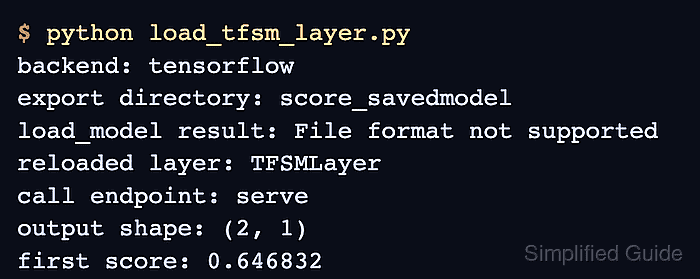
$ python load_tfsm_layer.py
backend: tensorflow
export directory: score_savedmodel
load_model result: File format not supported
reloaded layer: TFSMLayer
call endpoint: serve
output shape: (2, 1)
first score: 0.646832
The load_model failure is expected for a SavedModel directory in Keras 3. Confirm the TFSMLayer output shape before wrapping the artifact in a larger model.
- Use the reloaded layer inside another Keras model when the SavedModel is only one stage of the inference graph.
inputs = keras.Input(shape=(3,), name="features")
score = keras.layers.TFSMLayer("score_savedmodel", call_endpoint="serve")(inputs)
wrapped_model = keras.Model(inputs, score)

Mohd Shakir Zakaria is a cloud architect with deep roots in software development and open-source advocacy. Certified in AWS, Red Hat, VMware, ITIL, and Linux, he specializes in designing and managing robust cloud and on-premises infrastructures.


