Knowledge-base search can conceal missing documentation because a retriever still returns the nearest document when the corpus does not answer a question. A score-based audit in Haystack exposes those weak matches before a support bot or RAG pipeline treats them as usable context.
An InMemoryDocumentStore and InMemoryBM25Retriever provide a local audit surface without an external model or database. The audit labels a question FOUND only when its highest-scoring document reaches a threshold calibrated with questions the same knowledge base should and should not cover.
BM25 scores vary with corpus size, wording, and document length. A representative export and human review of each MISSING question keep unrelated top matches from becoming automatic writing assignments.
Steps to audit Haystack knowledge base gaps:
- Create audit_kb_gaps.py with the Haystack imports and representative knowledge-base documents.
- audit_kb_gaps.py
from haystack import Document
from haystack.components.retrievers.in_memory import InMemoryBM25Retriever
from haystack.document_stores.in_memory import InMemoryDocumentStore


documents = [
    Document(
        content="Users reset a forgotten password from Account settings with the password reset email.",
        meta={"title": "Password reset"},
    ),
    Document(
        content="Admins configure SAML single sign-on from Security settings with the identity provider metadata URL.",
        meta={"title": "SAML SSO setup"},
    ),
    Document(
        content="Billing owners change invoice recipients from Billing settings before the next invoice is issued.",
        meta={"title": "Invoice recipients"},
    ),
]
- Add covered and uncovered audit questions with an initial score threshold below documents.
questions = [
    "How do users reset a forgotten password?",
    "How do admins configure SAML single sign-on?",
    "Can I export a SOC 2 audit report?",
    "How can billing owners change invoice recipients?",
]

minimum_score = 4.0
A minimum_score calibrated with known covered and uncovered questions reflects the score distribution of the knowledge base being audited.
- Add the in-memory document store and top-match BM25 retriever below minimum_score.
document_store = InMemoryDocumentStore()
document_store.write_documents(documents)
retriever = InMemoryBM25Retriever(document_store=document_store, top_k=1)
- Define audit_question() below the retriever to retain each question, score, status, and top document.
def audit_question(question):
    matches = retriever.run(query=question)["documents"]
    top_document = matches[0] if matches else None
    score = top_document.score if top_document else 0.0

    return {
        "question": question,
        "status": "FOUND" if top_document and score >= minimum_score else "MISSING",
        "score": score,
        "title": top_document.meta["title"] if top_document else "none",
    }
- Finish audit_kb_gaps.py with the per-question report and missing-question summary.
results = [audit_question(question) for question in questions]

for result in results:
    print(
        f"{result['status']} | score={result['score']:.2f} | "
        f"question={result['question']}"
    )
    print(f"top_document={result['title']}")
    print()

missing_questions = [
    result["question"] for result in results if result["status"] == "MISSING"
]

print(f"summary_found={len(results) - len(missing_questions)}")
print(f"summary_missing={len(missing_questions)}")
print("missing_questions=" + "; ".join(missing_questions))
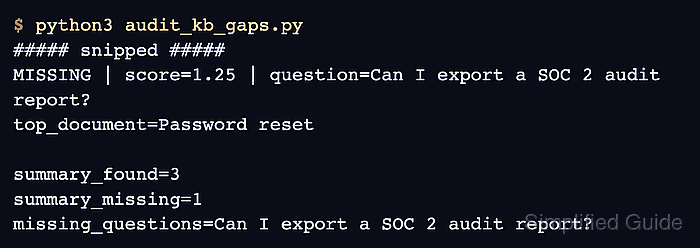
- Run the completed knowledge-base audit with the active Haystack Python environment.
$ python3 audit_kb_gaps.py
FOUND | score=6.86 | question=How do users reset a forgotten password?
top_document=Password reset

FOUND | score=7.23 | question=How do admins configure SAML single sign-on?
top_document=SAML SSO setup

MISSING | score=1.25 | question=Can I export a SOC 2 audit report?
top_document=Password reset

FOUND | score=6.74 | question=How can billing owners change invoice recipients?
top_document=Invoice recipients

summary_found=3
summary_missing=1
missing_questions=Can I export a SOC 2 audit report?
The unrelated password-reset match and low score identify the SOC 2 question as the missing content candidate rather than a marginally covered question.

Mohd Shakir Zakaria is a cloud architect with deep roots in software development and open-source advocacy. Certified in AWS, Red Hat, VMware, ITIL, and Linux, he specializes in designing and managing robust cloud and on-premises infrastructures.


