Intermittent throttling, temporary service errors, and short network failures can make the same AWS CLI command fail in one run and succeed in the next. Setting a profile's retry mode keeps the client on a predictable retry policy for that shell, script, or batch job.
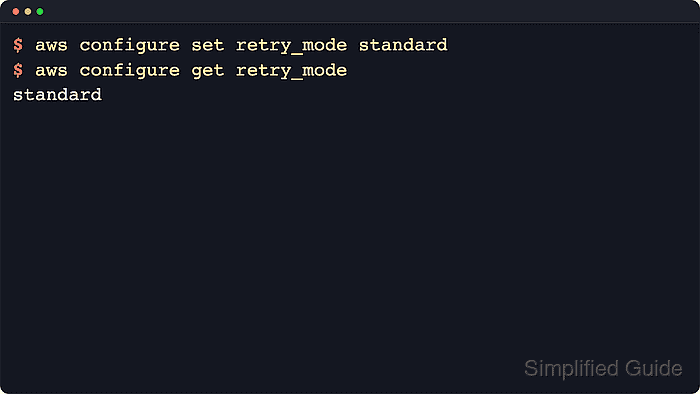
The saved setting is retry_mode in the shared AWS CLI config file. aws configure set writes the value to [default] or a named [profile NAME] section, and aws configure get reads back the file-backed value without making an AWS service request.
AWS CLI v2 uses standard mode by default. legacy keeps the older retry handler, while adaptive adds client-side rate limiting and is still documented as experimental. max_attempts is a separate setting that changes the total number of calls allowed for a request, including the first call.
Steps to set retry mode in AWS CLI:
- Choose the retry mode for the profile workload.
Retry mode Best fit Default total calls Notes standard Daily CLI work and most automation 3 Default for AWS CLI v2 legacy Older scripts that must preserve the older retry handler 5 Retries fewer error types than standard; DynamoDB has a higher legacy default adaptive Specialized clients that also need client-side rate limiting 3 Experimental and subject to change - Save standard on the default profile.
$ aws configure set retry_mode standard --profile default
No output means the value was saved. The command writes retry_mode = standard under [default] in the active shared config file.
- Read the saved default profile value.
$ aws configure get retry_mode --profile default
standard
aws configure get confirms the stored profile value. It does not show a shell-level AWS_RETRY_MODE override.
- Set a custom retry attempt count only when the profile needs one.
$ aws configure set max_attempts 5 --profile default
max_attempts counts the first request plus retries. Omit this setting when the retry mode default is enough for the workload.
- Read the saved retry attempt count.
$ aws configure get max_attempts --profile default
5
- Save a different retry mode on a named profile when one workload should not inherit the default profile behavior.
$ aws configure set retry_mode adaptive --profile batch
adaptive mode is experimental. Use standard unless the client-side rate limit behavior is intentional for that workload.
- Read the named profile value before using it in automation.
$ aws configure get retry_mode --profile batch
adaptive
The --profile option selects the config section to read or write. It does not change other profiles.
Related: How to configure multiple AWS CLI profiles - Inspect the shared config file when the exact stored sections need to be reviewed.
$ cat ~/.aws/config
[default]
retry_mode = standard
max_attempts = 5
[profile batch]
retry_mode = adaptive
If AWS_CONFIG_FILE is set, inspect that file instead of ~/.aws/config. On Windows, the default shared config file is %UserProfile%\.aws\config.
Related: How to find the AWS CLI config file location - Check whether the current shell is overriding the saved retry mode.
$ printenv AWS_RETRY_MODE
legacy
If this command prints a value, the environment variable wins for commands launched from that shell. Clear AWS_RETRY_MODE and AWS_MAX_ATTEMPTS when the saved profile should take effect.
Related: How to use AWS CLI environment variables

Mohd Shakir Zakaria is a cloud architect with deep roots in software development and open-source advocacy. Certified in AWS, Red Hat, VMware, ITIL, and Linux, he specializes in designing and managing robust cloud and on-premises infrastructures.


