How to load a TensorFlow SavedModel
A SavedModel is the TensorFlow handoff artifact for running an exported inference graph outside the training script. Loading it in Python is a fast smoke test before the model moves into a service, batch job, converter, or another runtime.
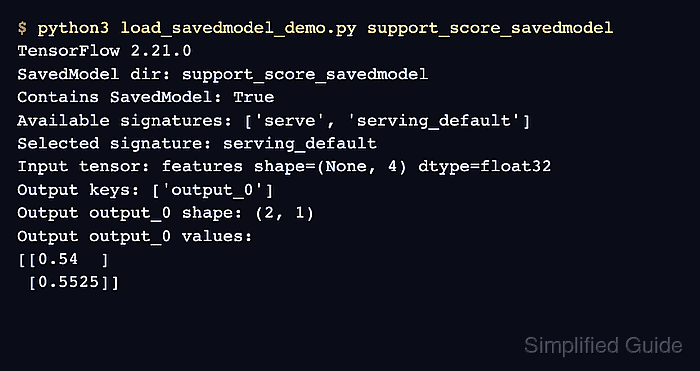
The low-level tf.saved_model.load() API returns a trackable object, not a rehydrated training model. Keras 3 exports commonly expose serve and serving_default endpoints, and the selected endpoint controls the input key and output dictionary used by the caller.
A complete export directory must be available in the active environment before loading begins. Copy the whole directory, including saved_model.pb and variables, and prepare a sample tensor with the shape and dtype shown by the serving signature.
Steps to load a TensorFlow SavedModel:
- Open a terminal in the Python environment that imports TensorFlow and can read the SavedModel directory.
Use tf.saved_model.load() for direct TensorFlow endpoint calls. Use a Keras TFSMLayer when the SavedModel has to become a layer inside a Keras model.
- Confirm the export path points at the complete SavedModel directory.
$ ls support_score_savedmodel
assets
fingerprint.pb
saved_model.pb
variables
Copy the whole directory, not only saved_model.pb, because variables and assets can live outside the protobuf file.
- Save the loader script as
load_savedmodel_demo.py
.
- load_savedmodel_demo.py
import argparse
import os
import pathlib

os.environ["TF_CPP_MIN_LOG_LEVEL"] = "2"

import tensorflow as tf

tf.get_logger().setLevel("ERROR")


def shape_tuple(shape):
    dims = shape.as_list()
    return tuple(None if dim is None else dim for dim in dims)


parser = argparse.ArgumentParser()
parser.add_argument("savedmodel_dir", help="Path to a TensorFlow SavedModel directory")
args = parser.parse_args()

model_dir = pathlib.Path(args.savedmodel_dir)
if not tf.saved_model.contains_saved_model(str(model_dir)):
    raise SystemExit(f"{model_dir} is not a TensorFlow SavedModel directory")

artifact = tf.saved_model.load(str(model_dir))
signature_names = sorted(artifact.signatures.keys())
if not signature_names:
    raise SystemExit("No callable signatures found in SavedModel")

signature_name = "serving_default" if "serving_default" in artifact.signatures else signature_names[0]
signature = artifact.signatures[signature_name]
_, keyword_inputs = signature.structured_input_signature
if len(keyword_inputs) != 1:
    raise SystemExit(f"Expected one keyword input, found {sorted(keyword_inputs.keys())}")

input_name, input_spec = next(iter(keyword_inputs.items()))
sample_batch = tf.constant(
    [
        [0.15, 0.75, 0.35, 0.45],
        [0.85, 0.25, 0.65, 0.75],
    ],
    dtype=input_spec.dtype,
)
outputs = signature(**{input_name: sample_batch})

print(f"TensorFlow {tf.__version__}")
print(f"SavedModel dir: {model_dir}")
print(f"Contains SavedModel: {tf.saved_model.contains_saved_model(str(model_dir))}")
print(f"Available signatures: {signature_names}")
print(f"Selected signature: {signature_name}")
print(f"Input tensor: {input_name} shape={shape_tuple(input_spec.shape)} dtype={input_spec.dtype.name}")
print(f"Output keys: {sorted(outputs.keys())}")

for output_name in sorted(outputs.keys()):
    output_tensor = outputs[output_name]
    rounded = tf.round(output_tensor * 10000) / 10000
    print(f"Output {output_name} shape: {tuple(output_tensor.shape)}")
    print(f"Output {output_name} values:")
    print(rounded.numpy())
Replace support_score_savedmodel and the sample_batch values with the directory, shape, and dtype from the exported model.
- Run the loader against the SavedModel directory.
$ python3 load_savedmodel_demo.py support_score_savedmodel
TensorFlow 2.21.0
SavedModel dir: support_score_savedmodel
Contains SavedModel: True
Available signatures: ['serve', 'serving_default']
Selected signature: serving_default
Input tensor: features shape=(None, 4) dtype=float32
Output keys: ['output_0']
Output output_0 shape: (2, 1)
Output output_0 values:
[[0.54  ]
 [0.5525]]
The printed Input tensor and Output keys are the values to map into a serving request, batch inference job, or downstream client.
- Remove the temporary smoke-test script after recording the signature and output contract.
$ rm load_savedmodel_demo.py
Skip this cleanup when the loader becomes part of a release checklist or model handoff test.