How to run PHPUnit tests in Symfony
Automated tests let a Symfony project check application code before a change reaches a shared branch or deployment. PHPUnit is the test runner Symfony uses for unit, integration, and application tests, and the project-level wrapper reads the same configuration that CI jobs usually call.
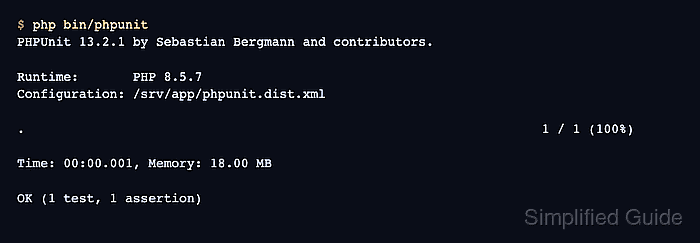
Symfony Flex creates bin/phpunit, phpunit.dist.xml, and tests/bootstrap.php when the test packages are installed. The wrapper runs PHPUnit from the project dependencies, loads the test environment, and discovers test classes under tests/.
Use the project root as the working directory so PHPUnit can find the Symfony bootstrap and configuration file. A passing run ends with OK and returns exit code 0; failures, errors, warnings configured as failures, or missing tests return a nonzero status for CI and deployment gates.
Related: How to create a Symfony project
Related: How to debug the Symfony service container
Steps to run Symfony PHPUnit tests:
- Open a terminal in the Symfony project root.
If bin/phpunit is missing in a new project, install the Symfony test pack with composer require --dev symfony/test-pack before running the suite.
- Run the full PHPUnit suite.
$ php bin/phpunit
PHPUnit 13.2.1 by Sebastian Bergmann and contributors.

Runtime:       PHP 8.5.7
Configuration: /srv/app/phpunit.dist.xml

.                                                                   1 / 1 (100%)

Time: 00:00.001, Memory: 18.00 MB

OK (1 test, 1 assertion)
phpunit.dist.xml controls bootstrap, test environment variables, and test suite discovery for the normal project run.
- Run one test file when only one area changed.
$ php bin/phpunit tests/Service/SluggerTest.php
PHPUnit 13.2.1 by Sebastian Bergmann and contributors.

Runtime:       PHP 8.5.7
Configuration: /srv/app/phpunit.dist.xml

.                                                                   1 / 1 (100%)

Time: 00:00.001, Memory: 18.00 MB

OK (1 test, 1 assertion)
Symfony discovers test classes ending in Test under tests/. Pointing PHPUnit at a file narrows the run without changing the XML configuration.
- Run one test method with --filter when a failure needs a smaller loop.
$ php bin/phpunit --filter testSlugifiesText
PHPUnit 13.2.1 by Sebastian Bergmann and contributors.

Runtime:       PHP 8.5.7
Configuration: /srv/app/phpunit.dist.xml

.                                                                   1 / 1 (100%)

Time: 00:00.002, Memory: 18.00 MB

OK (1 test, 1 assertion)
PHPUnit treats the filter value as a regular expression, so escape backslashes when filtering by a fully qualified class name.
- Confirm the latest PHPUnit command returned success for scripts or CI.
$ echo $?
0
Run the exit-status check immediately after PHPUnit. Another shell command replaces the saved status value.