The Symfony service container decides which objects are built and injected when controllers, console commands, event subscribers, and application services run. Inspecting the compiled container helps when a type-hint receives an unexpected service, a tagged class is missing, or a custom service is not visible from bin/console.
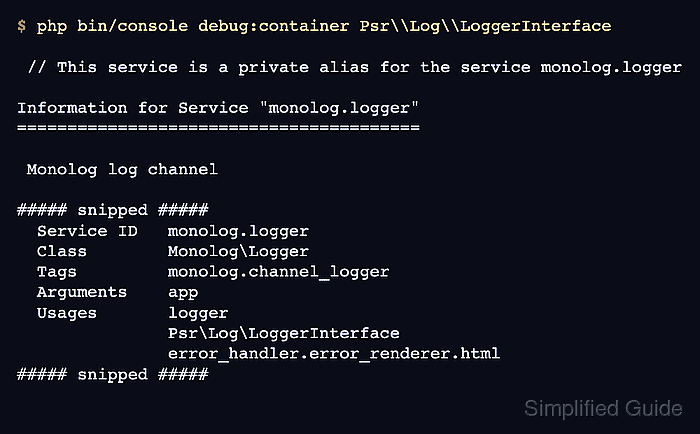
The debug:container command reads the container for one environment and shows service IDs, aliases, tags, constructor arguments, and usages. The debug:autowiring command is the clearer view when the question is which class or interface to type-hint, or which #[Target] variant Symfony will inject.
Run the checks from the project root that contains bin/console. Use the same environment as the failure, because dev, test, and prod can load different bundles, configuration blocks, debug wrappers, and optimized services.
Related: How to create a Symfony project
Related: How to create a Symfony console command
Related: How to enable the Symfony profiler
Steps to debug the Symfony service container:
- Open a terminal in the Symfony project root.
- Confirm the console environment that will be inspected.
$ php bin/console about
 -------------------- ---------------------------------
  Symfony
 -------------------- ---------------------------------
  Version              v8.1.0
  Environment          dev
  Debug                true
 -------------------- ---------------------------------
  PHP
 -------------------- ---------------------------------
  Version              8.4.22
  OPcache              Enabled
 -------------------- ---------------------------------
Pass --env=prod, --env=test, or --no-debug to the later debug commands when the failing behavior appears outside the default dev container.
- Search for the service ID, alias, or short term from the error message.
$ php bin/console debug:container mailer

 // This service is a private alias for the service mailer.mailer

Information for Service "mailer.mailer"
=======================================

 ---------------- ---------------------------------------------
  Option           Value
 ---------------- ---------------------------------------------
  Service ID       mailer.mailer
  Class            Symfony\Component\Mailer\Mailer
  Public           no
  Arguments        Service(mailer.transports)
                   Service(debug.traced.messenger.bus.default)
                   Service(debug.event_dispatcher)
  Usages           mailer
                   Symfony\Component\Mailer\MailerInterface
 ---------------- ---------------------------------------------

 ! [NOTE] The "mailer" service or alias has been removed or inlined when the
 !        container was compiled.
The alias line, Class, Arguments, and Usages fields identify what Symfony will build or inject. A removed-or-inlined note is common for private optimized services and is not by itself a registration failure.
- Check the autowiring type-hints when a constructor receives the wrong dependency.
$ php bin/console debug:autowiring logger

Autowirable Types
=================

 Use the following classes & interfaces as type-hints in constructor arguments to autowire services.
 Add #[Target('name')] to the argument to select a specific variant.
 (only showing classes/interfaces matching logger)

 Psr\Log\LoggerInterface -> monolog.logger
   Describes a logger instance.
   #[Target('asset_mapper')] -> monolog.logger.asset_mapper
   #[Target('cache')] -> monolog.logger.cache
   #[Target('console')] -> monolog.logger.console
   #[Target('debug')] -> monolog.logger.debug
   #[Target('deprecation')] -> monolog.logger.deprecation
   #[Target('doctrine')] -> monolog.logger.doctrine
   #[Target('event')] -> monolog.logger.event
   #[Target('http_client')] -> monolog.logger.http_client
   #[Target('mailer')] -> monolog.logger.mailer
##### snipped #####
Use the plain interface when the default service is correct. Use #[Target('mailer')] or another listed target when the constructor needs a named variant.
- List services for the tag when autoconfiguration or event registration is the suspected layer.
$ php bin/console debug:container --tag=kernel.event_subscriber

Symfony Container Services Tagged with "kernel.event_subscriber" Tag
====================================================================

 ----------------------------------------------------------------------- -------------------------------------- ---------------------------------------------------------------------------------------
  Service ID                                                              dispatcher                             Class name
 ----------------------------------------------------------------------- -------------------------------------- ---------------------------------------------------------------------------------------
  console.error_listener                                                                                         Symfony\Component\Console\EventListener\ErrorListener
  argument_resolver.request_payload                                                                              Symfony\Component\HttpKernel\Controller\ArgumentResolver\RequestPayloadValueResolver
  response_listener                                                                                              Symfony\Component\HttpKernel\EventListener\ResponseListener
  locale_listener                                                                                                Symfony\Component\HttpKernel\EventListener\LocaleListener
  validate_request_listener                                                                                      Symfony\Component\HttpKernel\EventListener\ValidateRequestListener
##### snipped #####
  web_profiler.debug_toolbar                                                                                     Symfony\Bundle\WebProfilerBundle\EventListener\WebDebugToolbarListener
  controller.is_granted_attribute_listener                                                                       Symfony\Component\Security\Http\EventListener\IsGrantedAttributeListener
  security.listener.check_authenticator_credentials                                                              Symfony\Component\Security\Http\EventListener\CheckCredentialsListener
 ----------------------------------------------------------------------- -------------------------------------- ---------------------------------------------------------------------------------------
Replace kernel.event_subscriber with the tag named in the error, bundle documentation, or expected autoconfiguration path, such as console.command, messenger.message_handler, or twig.extension.
- Inspect the application service loading rules when a class under src/ is missing.
$ cat config/services.yaml
# yaml-language-server: $schema=../vendor/symfony/dependency-injection/Loader/schema/services.schema.json

parameters:

services:
    # default configuration for services in *this* file
    _defaults:
        autowire: true      # Automatically injects dependencies in your services.
        autoconfigure: true # Automatically registers your services as commands, event subscribers, etc.

    # makes classes in src/ available to be used as services
    # this creates a service per class whose id is the fully-qualified class name
    App\:
        resource: '../src/'

    # add more service definitions when explicit configuration is needed
    # please note that last definitions always *replace* previous ones
If the class is outside the loaded resource path, excluded by a later rule, or overridden by a later definition, adjust the service configuration before searching the container again.
- Re-run an exact service or type-hint lookup after choosing the ID to use in code or configuration.
$ php bin/console debug:container Psr\\Log\\LoggerInterface

 // This service is a private alias for the service monolog.logger

Information for Service "monolog.logger"
========================================

 Monolog log channel

 ---------------- ----------------------------------------------------
  Option           Value
 ---------------- ----------------------------------------------------
  Service ID       monolog.logger
  Class            Monolog\Logger
  Tags             monolog.channel_logger
  Calls            useMicrosecondTimestamps, pushHandler, pushHandler
  Public           no
  Arguments        app
  Usages           logger
                   Psr\Log\LoggerInterface
                   error_handler.error_renderer.html
                   asset_mapper.compressor
                   doctrine.migrations.dependency_factory
 ---------------- ----------------------------------------------------

Mohd Shakir Zakaria is a cloud architect with deep roots in software development and open-source advocacy. Certified in AWS, Red Hat, VMware, ITIL, and Linux, he specializes in designing and managing robust cloud and on-premises infrastructures.


