Table of Contents
How to run hierarchical clustering with SciPy
Hierarchical clustering preserves the order and distance of every merge instead of returning only a final partition. SciPy stores that nested structure in a linkage matrix, while the boundary that turns it into flat clusters remains a separate modeling decision.
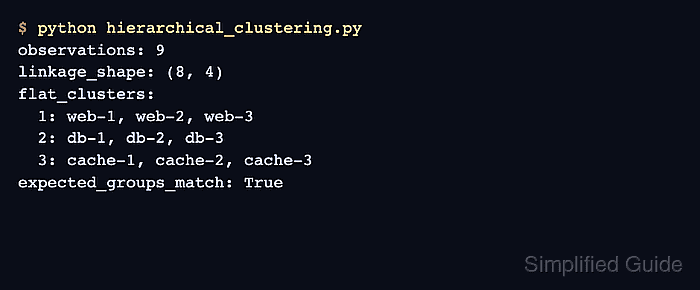
The sample uses nine labeled observations with two already standardized numeric features. Ward linkage is stated explicitly with Euclidean distance because its variance-minimization calculation is defined for Euclidean geometry.
The ordered merge distances expose a wide gap between the last within-group merge and the first between-group merge. A distance cut of 1.0 falls inside that gap, and label sets verify the resulting memberships without depending on SciPy's arbitrary numeric cluster IDs.
Steps to build and cut a SciPy linkage hierarchy:
Prepare labeled observations
- Prepare hierarchical_clustering.py with SciPy imports, labels, and the standardized observation matrix.
- hierarchical_clustering.py
import numpy as np
from scipy.cluster.hierarchy import fcluster, linkage


labels = np.array(
    [
        "web-1",
        "web-2",
        "web-3",
        "cache-1",
        "cache-2",
        "cache-3",
        "db-1",
        "db-2",
        "db-3",
    ]
)
observations = np.array(
    [
        [0.0, 0.1],
        [0.2, -0.1],
        [-0.2, 0.0],
        [0.1, 4.8],
        [-0.1, 5.1],
        [0.3, 5.0],
        [5.1, 4.9],
        [4.8, 5.2],
        [5.0, 5.1],
    ]
)
Each row is one observation and each column is one standardized numeric feature. Scale real columns before Ward clustering when their units or ranges differ.
Define the linkage boundary
- Declare Ward linkage with Euclidean distance for the standardized features.
linkage_method = "ward"
distance_metric = "euclidean"
Ward, centroid, and median linkage are defined only for Euclidean pairwise distances.
- Construct the linkage matrix from the observation rows.
linkage_matrix = linkage(
    observations,
    method=linkage_method,
    metric=distance_metric,
)
- Extract the hierarchy's ordered merge distances for cut inspection.
merge_distances = linkage_matrix[:, 2]
Nine observations produce eight linkage rows. The third column records the distance at each successive merge.
Select and apply the flat-cluster cut
- Select a distance cut of 1.0 between the within-group and between-group merges.
cut_distance = 1.0
- Assign a flat cluster ID to each observation at the selected distance cut.
cluster_ids = fcluster(
    linkage_matrix,
    t=cut_distance,
    criterion="distance",
)
The distance criterion keeps observations together only while their cophenetic distance stays at or below the selected cut.
Report memberships independently of cluster numbers
- Group the observation labels by their assigned flat cluster ID.
memberships = {}
for label, cluster_id in zip(labels, cluster_ids):
    memberships.setdefault(int(cluster_id), []).append(label)

membership_rows = sorted(
    sorted(members)
    for members in memberships.values()
)
- Print the linkage choice, merge distances, cut, and sorted membership rows.
print(f"linkage: {linkage_method} ({distance_metric})")
print("merge_distances:", np.round(merge_distances, 3).tolist())
print(f"cut_distance: {cut_distance:.1f}")
print("memberships:")
for members in membership_rows:
    print(f"  {', '.join(members)}")
Verify the expected grouping
- Define the expected memberships without using SciPy's numeric cluster IDs.
expected_groups = {
    frozenset(["web-1", "web-2", "web-3"]),
    frozenset(["cache-1", "cache-2", "cache-3"]),
    frozenset(["db-1", "db-2", "db-3"]),
}
- Reject any membership set that differs from the expected service groups.
observed_groups = {
    frozenset(members)
    for members in membership_rows
}

if observed_groups != expected_groups:
    raise RuntimeError("Flat clusters did not match the expected groups")

print("membership_check: passed")
Execute the completed hierarchy
- Execute the completed clustering script with Python 3.
$ python3 hierarchical_clustering.py
linkage: ward (euclidean)
merge_distances: [0.224, 0.224, 0.283, 0.37, 0.387, 0.416, 8.431, 11.24]
cut_distance: 1.0
memberships:
  cache-1, cache-2, cache-3
  db-1, db-2, db-3
  web-1, web-2, web-3
membership_check: passed
The script exits with an error instead of printing membership_check: passed when any observed label set differs from the expected groups.