How to create a Delaunay triangulation with SciPy
A scattered coordinate set does not show which samples share a local face. Delaunay triangulation turns those coordinates into a non-overlapping simplex mesh for spatial lookup, interpolation, and mesh preparation.
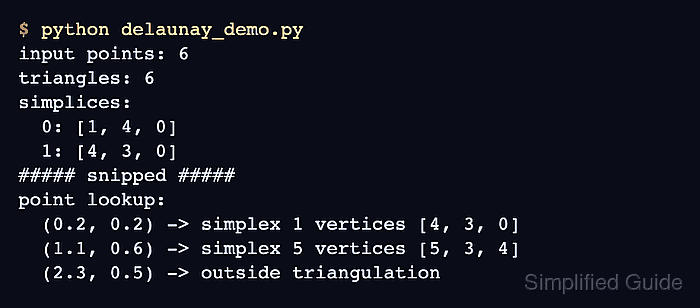
SciPy's scipy.spatial.Delaunay accepts a floating-point NumPy array and delegates tessellation to Qhull. Its simplices rows contain indexes into the original point array; each row has three counterclockwise vertex indexes for two-dimensional input.
The five input points include a rectangular boundary and one interior sample, so the triangle areas can be checked against the boundary area. Two inside queries and one outside query also expose the -1 result that must be guarded before simplices is indexed.
Steps to create a Delaunay triangulation with SciPy:
- Create delaunay_demo.py with the SciPy import and two-dimensional point array.
$ cat > delaunay_demo.py <<'PY'
import numpy as np
from scipy.spatial import Delaunay

points = np.array([
    [0.0, 0.0],
    [2.0, 0.0],
    [2.0, 2.0],
    [0.0, 2.0],
    [0.9, 0.7],
])
PY
The first four rows form the boundary, and the last row adds an interior vertex.
- Append the triangulation and stable vertex-index report to delaunay_demo.py.
$ cat >> delaunay_demo.py <<'PY'

triangulation = Delaunay(points)
triangles = points[triangulation.simplices]

vertex_sets = sorted(
    sorted(int(index) for index in simplex)
    for simplex in triangulation.simplices
)
print("triangle vertex indexes:")
for vertices in vertex_sets:
    print(f"  {vertices}")
PY
SciPy may return simplex rows in a different order when floating-point rounding differs. Sorting the report keeps its presentation stable without changing triangulation.simplices or assuming a fixed simplex number.
- Append the triangle-area coverage check to delaunay_demo.py.
$ cat >> delaunay_demo.py <<'PY'

edge_a = triangles[:, 1] - triangles[:, 0]
edge_b = triangles[:, 2] - triangles[:, 0]
triangle_areas = 0.5 * np.abs(
    edge_a[:, 0] * edge_b[:, 1]
    - edge_a[:, 1] * edge_b[:, 0]
)

boundary = points[:4]
next_boundary = np.roll(boundary, -1, axis=0)
boundary_area = 0.5 * abs(
    np.sum(boundary[:, 0] * next_boundary[:, 1])
    - np.sum(boundary[:, 1] * next_boundary[:, 0])
)

np.testing.assert_allclose(triangle_areas.sum(), boundary_area)
print(f"triangles: {len(triangles)}")
print(f"triangulated area: {triangle_areas.sum():.3f}")
print(f"boundary area: {boundary_area:.3f}")
PY
Duplicate, collinear, or nearly coplanar input can omit vertices or produce degenerate simplices. The triangulation.coplanar attribute records omitted points, while a Qhull option such as QJ perturbs input and may create zero-area triangles.
- Append the guarded point-location check to delaunay_demo.py.
$ cat >> delaunay_demo.py <<'PY'

query_points = np.array([
    [0.2, 0.2],
    [1.7, 0.4],
    [2.3, 0.5],
])
query_simplexes = triangulation.find_simplex(query_points)

assert np.all(query_simplexes[:2] >= 0)
assert query_simplexes[2] == -1

print("point lookup:")
for point, simplex_index in zip(query_points, query_simplexes):
    label = (
        "outside triangulation"
        if simplex_index == -1
        else f"inside vertices {sorted(triangulation.simplices[simplex_index].tolist())}"
    )
    print(f"  ({point[0]:.1f}, {point[1]:.1f}) -> {label}")
PY
An outside lookup returns -1, which Python would otherwise interpret as the last row of triangulation.simplices.
- Run delaunay_demo.py to print the complete geometric report.
$ python3 delaunay_demo.py
triangle vertex indexes:
  [0, 1, 4]
  [0, 3, 4]
  [1, 2, 4]
  [2, 3, 4]
triangles: 4
triangulated area: 4.000
boundary area: 4.000
point lookup:
  (0.2, 0.2) -> inside vertices [0, 3, 4]
  (1.7, 0.4) -> inside vertices [1, 2, 4]
  (2.3, 0.5) -> outside triangulation