How to export a PyTorch model with torch.export
Deployment tools cannot rely on an eager Python module when they need a normalized tensor graph with explicit shape constraints. torch.export captures that graph as an ExportedProgram that can be inspected, serialized, and executed through PyTorch's exported-program runtime.
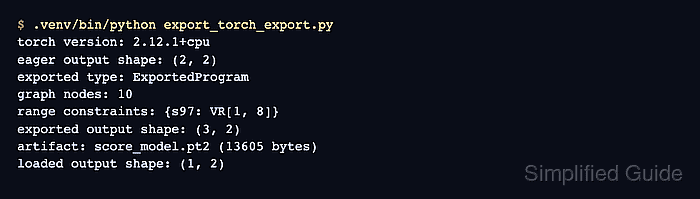
Example inputs define the tracing contract. The first batch dimension uses Dim(“batch”, min=1, max=8) so the loaded program accepts a batch of three even though export begins with a batch of two.
Saved export files conventionally use .pt2, but PyTorch treats their serialization format as under active development; keep producer and consumer versions aligned. torch.export.load uses pickle, so load only artifacts from a trusted source.
Related: How to install PyTorch with pip
Related: How to export a PyTorch model to ONNX
Related: How to export a PyTorch model to TorchScript
Steps to export a PyTorch model with torch.export:
- Create the model definition in export_torch_export.py.
- export_torch_export.py
from pathlib import Path

import torch
from torch import nn
from torch.export import Dim


class ScoreModel(nn.Module):
    def __init__(self):
        super().__init__()
        self.layers = nn.Sequential(
            nn.Linear(4, 8),
            nn.ReLU(),
            nn.Linear(8, 2),
        )

    def forward(self, features):
        return torch.softmax(self.layers(features), dim=-1)
The ScoreModel class and its four input features are compact stand-ins for the model and tensor contract being exported.
- Add the export input contract below the model class.
torch.manual_seed(7)
model = ScoreModel().eval()
example_inputs = (torch.randn(2, 4),)
dynamic_shapes = {"features": {0: Dim("batch", min=1, max=8)}}

exported = torch.export.export(
    model,
    example_inputs,
    dynamic_shapes=dynamic_shapes,
)
eval() makes dropout and batch-normalization modules use inference behavior.
- Append the artifact round-trip block below the export call.
artifact = Path("score_model.pt2")
torch.export.save(exported, artifact)
loaded = torch.export.load(artifact)

test_input = torch.randn(3, 4)
eager_output = model(test_input)
loaded_output = loaded.module()(test_input)
torch.testing.assert_close(eager_output, loaded_output)

print(f"exported type: {type(exported).__name__}")
print(f"dynamic output shape: {tuple(loaded_output.shape)}")
print(f"outputs match: {torch.allclose(eager_output, loaded_output)}")
print(f"artifact saved: {artifact.exists()}")
- Run the completed export program to verify the loaded artifact matches eager output.
$ python export_torch_export.py
exported type: ExportedProgram
dynamic output shape: (3, 2)
outputs match: True
artifact saved: True