Deployment runtimes often need a model artifact that does not depend on the original Python class or training process. ONNX provides that handoff by representing the captured tensor computation as a graph that runtimes such as ONNX Runtime can load directly.
The torch.export-based exporter behind torch.onnx.export(…, dynamo=True) is the recommended PyTorch path. It captures the module with representative tensor inputs, translates supported operations, and returns an ONNXProgram that can be saved without passing a legacy output-path argument to the exporter.
An exported file still needs two separate checks before deployment. The ONNX checker catches an invalid graph, while a CPU ONNX Runtime inference and numeric comparison catch input-name, output-name, shape, and translation problems that graph validation alone cannot expose.
Steps to export a PyTorch model to ONNX:
- Install the ONNX exporter and CPU runtime dependencies in the active PyTorch environment.
$ python -m pip install --upgrade onnx onnxscript onnxruntime
This command belongs in the environment that already imports the project model; the PyTorch package itself comes from the project's chosen CPU or accelerator package source.
Related: How to install PyTorch with pip - Create export_onnx_smoke.py containing the imports and representative classifier setup.
- export_onnx_smoke.py
import numpy as np
import onnx
import onnxruntime as ort
import torch


class SmallClassifier(torch.nn.Module):
    def __init__(self):
        super().__init__()
        self.layers = torch.nn.Sequential(
            torch.nn.Linear(4, 8),
            torch.nn.ReLU(),
            torch.nn.Linear(8, 3),
        )

    def forward(self, features):
        return self.layers(features)


torch.manual_seed(7)
model = SmallClassifier().eval()
example_input = torch.randn(1, 4)
SmallClassifier and example_input stand in for the project module and a tensor tuple whose dtypes and dimensions match deployment traffic. The CPU smoke test expects the module and inputs on CPU.
- Append the ONNXProgram export and serialization block to export_onnx_smoke.py.
onnx_program = torch.onnx.export(
    model,
    (example_input,),
    dynamo=True,
    input_names=["features"],
    output_names=["scores"],
)
onnx_program.save("small-classifier.onnx")
The example exports a fixed input shape. Supply dynamic_shapes to torch.onnx.export() when a deployment dimension such as batch size must vary.
- Append the graph checker and CPU ONNX Runtime inference block to export_onnx_smoke.py.
onnx_model = onnx.load("small-classifier.onnx")
onnx.checker.check_model(onnx_model)

session = ort.InferenceSession(
    "small-classifier.onnx",
    providers=["CPUExecutionProvider"],
)
ort_output = session.run(
    ["scores"],
    {"features": example_input.numpy()},
)[0]
- Append the PyTorch parity assertion and result reporting block to export_onnx_smoke.py.
with torch.no_grad():
    torch_output = model(example_input).numpy()

np.testing.assert_allclose(torch_output, ort_output, rtol=1e-5, atol=1e-6)
max_difference = np.max(np.abs(torch_output - ort_output))

print("exported: small-classifier.onnx")
print(f"runtime input: {session.get_inputs()[0].name}")
print(f"runtime output: {session.get_outputs()[0].name}")
print(f"runtime output shape: {ort_output.shape}")
print(f"max difference: {max_difference:.8f}")
assert_allclose() raises an error when the runtime output exceeds the chosen tolerances, so the printed summary appears only after both implementations agree.
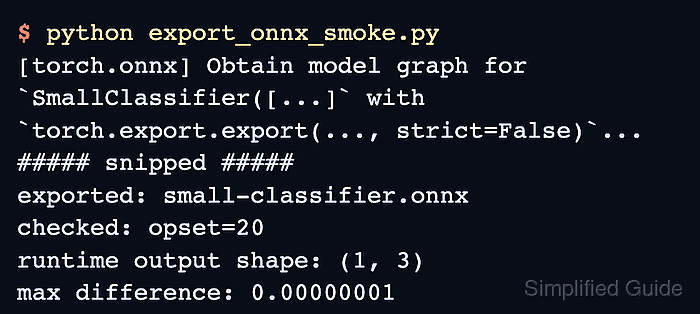
- Run export_onnx_smoke.py for the complete ONNX export smoke test.
$ python export_onnx_smoke.py
##### snipped #####
exported: small-classifier.onnx
runtime input: features
runtime output: scores
runtime output shape: (1, 3)
max difference: 0.00000001
Any exporter, checker, runtime, or parity error blocks the handoff. Unsupported operations, Python control flow, mismatched names, and shape constraints require correction before the ONNX file is suitable for a downstream runtime.

Mohd Shakir Zakaria is a cloud architect with deep roots in software development and open-source advocacy. Certified in AWS, Red Hat, VMware, ITIL, and Linux, he specializes in designing and managing robust cloud and on-premises infrastructures.


