How to decode a JSON response with PHP cURL
API requests made with PHP cURL often return a JSON body that should not be decoded until the transfer and HTTP status are known. Capture the response with CURLOPT_RETURNTRANSFER, check the status, then decode the body into a PHP array so application code reads known fields instead of raw text.
curl_exec() returns the response body to PHP when CURLOPT_RETURNTRANSFER is enabled. HTTP error responses are still completed transfers, so the script needs curl_getinfo() for the status code and content type before it trusts the body as JSON.
json_decode() with JSON_THROW_ON_ERROR turns parse failures into JsonException instead of returning null for several different cases. Add JSON_BIGINT_AS_STRING when API identifiers may exceed PHP's integer range, then validate the expected fields before passing decoded data to the rest of the application.
Steps to decode a JSON response with PHP cURL:
- Confirm that the PHP cURL extension is loaded in the runtime that will run the script.
$ php -r "var_export(extension_loaded('curl')); echo PHP_EOL;"
true
Install or enable the platform package for the extension, such as php-curl on Debian or Ubuntu systems, when this command prints false.
- Create a local JSON endpoint for repeatable testing.
- json-api.php
<?php
header('Content-Type: application/json; charset=UTF-8');
echo '{"profile":{"name":"Ada Lovelace","plan":"pro","account_id":12345678901234567890},"features":["api","exports"]}';
The unquoted account_id value is intentionally larger than a normal PHP integer on some systems, so the client can prove that JSON_BIGINT_AS_STRING preserves it as text.
- Start PHP's built-in server for the test endpoint in a second terminal.
$ php -S 127.0.0.1:8080 json-api.php
Keep this terminal open until the verification request finishes, then stop it with Ctrl+C.
- Create the PHP cURL client script that checks the transfer, HTTP response, content type, and decoded fields.
- decode-response.php
<?php
$url = $argv[1] ?? 'http://127.0.0.1:8080/profile';

$ch = curl_init($url);
curl_setopt_array($ch, [
    CURLOPT_RETURNTRANSFER => true,
    CURLOPT_HTTPHEADER => [
        'Accept: application/json',
    ],
    CURLOPT_TIMEOUT => 10,
]);

$body = curl_exec($ch);
if ($body === false) {
    fwrite(STDERR, 'cURL error: ' . curl_error($ch) . PHP_EOL);
    curl_close($ch);
    exit(1);
}

$status = curl_getinfo($ch, CURLINFO_HTTP_CODE);
$contentType = curl_getinfo($ch, CURLINFO_CONTENT_TYPE) ?: '';
curl_close($ch);

if ($status < 200 || $status >= 300) {
    fwrite(STDERR, "HTTP {$status}" . PHP_EOL);
    fwrite(STDERR, $body . PHP_EOL);
    exit(1);
}

if (!preg_match('/^application\/json\b/i', $contentType)) {
    fwrite(STDERR, "Unexpected Content-Type: {$contentType}" . PHP_EOL);
    exit(1);
}

try {
    $payload = json_decode($body, true, 512, JSON_THROW_ON_ERROR | JSON_BIGINT_AS_STRING);
} catch (JsonException $e) {
    fwrite(STDERR, 'JSON error: ' . $e->getMessage() . PHP_EOL);
    exit(1);
}

$profile = $payload['profile'] ?? null;
$features = $payload['features'] ?? null;

if (!is_array($profile) || !isset($profile['name'], $profile['plan'], $profile['account_id']) || !is_array($features)) {
    fwrite(STDERR, "JSON response did not include the expected profile and features fields" . PHP_EOL);
    exit(1);
}

echo "HTTP {$status}" . PHP_EOL;
echo "Content-Type: {$contentType}" . PHP_EOL;
echo "Name: " . $profile['name'] . PHP_EOL;
echo "Plan: " . $profile['plan'] . PHP_EOL;
echo "Account ID type: " . gettype($profile['account_id']) . PHP_EOL;
echo "Feature count: " . count($features) . PHP_EOL;
Use https:// for real API URLs and keep certificate verification enabled. Do not hide authentication, TLS, proxy, or redirect failures by decoding the body before checking the transfer and HTTP status.
- Run the decoder against the local endpoint and confirm that PHP receives decoded fields.
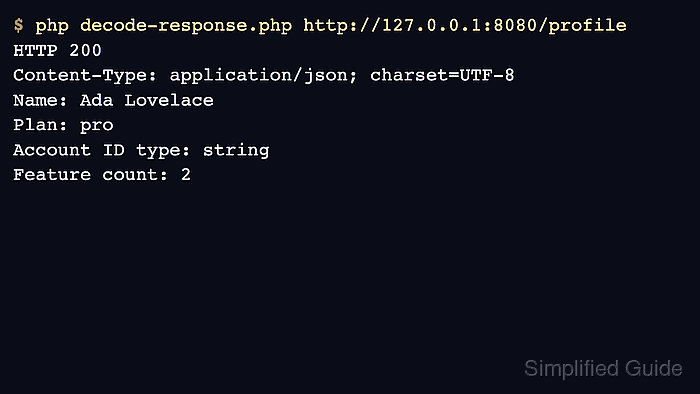
$ php decode-response.php http://127.0.0.1:8080/profile
HTTP 200
Content-Type: application/json; charset=UTF-8
Name: Ada Lovelace
Plan: pro
Account ID type: string
Feature count: 2
The string account ID type confirms that JSON_BIGINT_AS_STRING preserved the large identifier instead of converting it to a floating-point value.
- Point the script at the real API endpoint and adjust the field checks to the response shape.
Tool: JSON Validator can inspect a captured sample response for syntax errors, duplicate keys, unsafe numbers, and root-shape issues before field paths are hard-coded.