How to use API key secrets in Haystack
API keys often grant billable access to hosted models and data services, so application code should identify where a credential comes from without containing the credential itself. An environment-backed Haystack Secret gives a component that separation while keeping the pipeline serializable.
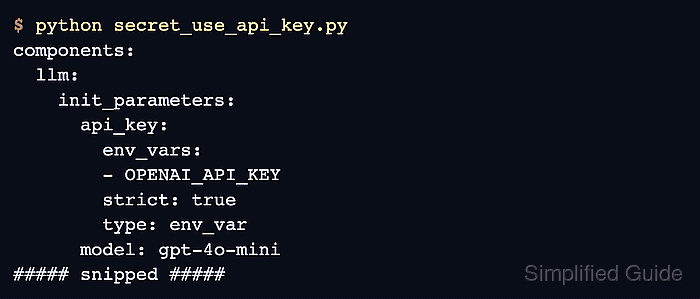
The Secret.from_env_var() method stores an environment-variable policy rather than its resolved value. The default strict behavior raises an error when the named variable is absent, while a configured process resolves the key only when the component needs it.
The OpenAIChatGenerator component already recognizes OPENAI_API_KEY by default, but passing an explicit Secret makes the credential source visible in the component configuration. Serializing the pipeline without contacting OpenAI checks disclosure behavior without consuming API requests.
Steps to use API key secrets in Haystack:
- Read the provider key into a non-echoing shell variable.
$ read -rsp "OpenAI API key: " OPENAI_API_KEY
The prompt keeps the key off the screen, but the shell still holds it in memory. A deployment secret manager is the appropriate credential source for a service, container, or CI job.
- Export OPENAI_API_KEY for the Python process started from the same shell.
$ export OPENAI_API_KEY
- Create the environment-backed Secret in secret_use_api_key.py.
- secret_use_api_key.py
from haystack import Pipeline
from haystack.components.generators.chat import OpenAIChatGenerator
from haystack.utils import Secret


api_key = Secret.from_env_var("OPENAI_API_KEY")
- Append the OpenAIChatGenerator initialization to secret_use_api_key.py.
generator = OpenAIChatGenerator(model="gpt-4o-mini", api_key=api_key)
- Append the pipeline serialization check to secret_use_api_key.py.
pipeline = Pipeline()
pipeline.add_component("llm", generator)
serialized = pipeline.dumps()

assert "OPENAI_API_KEY" in serialized
assert api_key.resolve_value() not in serialized
print(serialized)
The assertions stop execution if the saved policy omits the variable name or exposes the resolved key value.
- Run the completed script from the shell that exported OPENAI_API_KEY.
$ python secret_use_api_key.py
components:
  llm:
    init_parameters:
      api_base_url: null
      api_key:
        env_vars:
        - OPENAI_API_KEY
        strict: true
        type: env_var
      generation_kwargs: {}
      http_client_kwargs: null
      max_retries: null
      model: gpt-4o-mini
      organization: null
      streaming_callback: null
      timeout: null
      tools: null
      tools_strict: false
    type: haystack.components.generators.chat.openai.OpenAIChatGenerator
connection_type_validation: true
connections: []
max_runs_per_component: 100
metadata: {}
The serialized YAML should contain OPENAI_API_KEY under env_vars and must not contain the provider key entered at the prompt. A secret-pattern scan can catch unrelated custom fields before a larger pipeline is shared.
Tool: Secret Pattern Sample Checker