How to set the default model in Codex
When Codex starts with the wrong model, every new session can spend its first turn correcting model choice instead of using the intended capability, speed, and cost profile. A default model in Codex configuration pins that starting choice before the first prompt is sent.
Codex reads model settings from command-line flags first, then trusted project .codex/config.toml files, selected profile files, the user-level ~/.codex/config.toml file, system configuration, and built-in defaults. Put the setting in the user file when most local sessions should start with the same model, or in a trusted project file when only one repository needs that default.
Current Codex docs and CLI help expose the top-level model setting and the --model or -m launch flag. There is no current codex model set subcommand, and recurring alternate model choices now belong in separate profile files such as ~/.codex/fast.config.toml instead of legacy [profiles.fast] tables.
Steps to set the default Codex model:
- Create the user-level Codex config directory.
$ mkdir -p ~/.codex
- Open the user configuration file.
$ vi ~/.codex/config.toml
Use .codex/config.toml inside a trusted repository only when the model should apply to that project instead of every local Codex session.
- Set one top-level model value.
model = "gpt-5.5"
Use gpt-5.5 for demanding coding and tool-use work, or gpt-5.4-mini when speed and lower cost matter more than depth. If the active file already contains model = …, replace that line instead of adding a second top-level model entry.
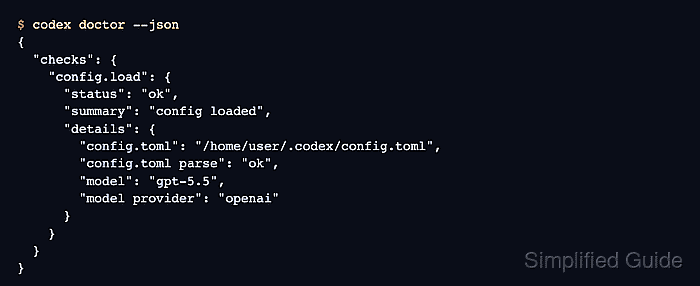
- Check that Codex loads the config file and sees the selected model.
$ codex doctor --json
{
  "schemaVersion": 1,
  "codexVersion": "0.139.0",
  "checks": {
    "config.load": {
      "status": "ok",
      "summary": "config loaded",
      "details": {
        "config.toml": "/home/user/.codex/config.toml",
        "config.toml parse": "ok",
        "model": "gpt-5.5",
        "model provider": "openai"
      }
    }
  }
  ##### snipped #####
}
codex doctor can also report authentication, network, or app-server checks. For this model change, the relevant signal is config.load showing config.toml parse as ok and model as the configured value.
- Start a new interactive session and confirm the header shows the configured model.
$ codex

╭──────────────────────────────────────────────────────────╮
│ >_ OpenAI Codex                                         │
│                                                          │
│ model:     gpt-5.5 high         /model to change        │
│ directory: ~/projects/example-app                       │
╰──────────────────────────────────────────────────────────╯

›
The exact reasoning suffix can differ by account or launch flags. If no cached login exists, complete authentication first and reopen the session.
Related: How to check Codex login status
Related: How to start a Codex interactive session - Override the default model for one run when the change should not persist.
$ codex exec -m gpt-5.4-mini "Reply with exactly OK."
OK
-m is shorthand for --model and has higher precedence than ~/.codex/config.toml for that command process.
Related: How to override Codex configuration for a single run
Related: How to run Codex exec with a prompt - Create a profile file when an alternate model should be reused by name.
$ vi ~/.codex/fast.config.toml
model = "gpt-5.4-mini"
Select the profile with codex --profile fast or codex exec --profile fast "...". Current Codex versions layer ~/.codex/fast.config.toml over the base config for runtime commands.