Request callbacks decide which spider method handles each downloaded page, so listing pages, detail pages, and follow-up pages do not all fall back into one generic parsing path. That keeps extraction logic readable when one response needs to schedule another response with a different parser.
In current Scrapy releases, both scrapy.Request() and response.follow() accept a callback argument that points to the method that should receive the downloaded Response. If callback is omitted, Scrapy sends the response to parse(), and cb_kwargs passes extra keyword arguments into the chosen callback without turning them into request metadata.
Callback wiring usually fails in three places: the followed selector returns no URL, the follow-up request forgets to set the intended callback, or the callback signature does not accept response first and the declared cb_kwargs after it. Keep callback-only values in cb_kwargs, and use meta only when request state must stay attached to the request itself for later callbacks or middleware.
Steps to use request callbacks in Scrapy:
- Change to the root of the Scrapy project that contains the spider.
$ cd callbackdemo
- Replace the spider with one callback for the quotes listing page and a second callback for the followed author page.
$ vi callbackdemo/spiders/quotes_callback.py
import scrapy


class QuotesCallbackSpider(scrapy.Spider):
    name = "quotes_callback"
    allowed_domains = ["quotes.toscrape.com"]
    start_urls = ["http://quotes.toscrape.com/"]

    def parse(self, response):
        for quote_card in response.css("div.quote"):
            author_href = quote_card.css("span a::attr(href)").get()
            quote_text = quote_card.css("span.text::text").get(default="").strip()

            if author_href:
                yield response.follow(
                    author_href,
                    callback=self.parse_author,
                    cb_kwargs={"quote_text": quote_text},
                )

    def parse_author(self, response, quote_text):
        yield {
            "quote": quote_text,
            "author": response.css("h3.author-title::text").get(default="").strip(),
            "born": response.css("span.author-born-date::text").get(default="").strip(),
            "url": response.url,
        }
response.follow() resolves the relative author URL against the current response automatically, while cb_kwargs carries the quote text into parse_author() without copying request metadata.
Keep response as the first parameter in parse_author() and match every cb_kwargs key in the method signature, or Scrapy raises a callback argument error when the followed response arrives.
- Run the spider and overwrite the previous export file for the current callback test.
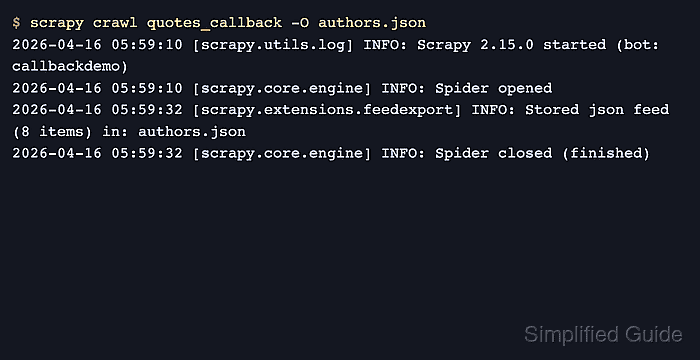
$ scrapy crawl quotes_callback -O authors.json
2026-04-22 06:37:14 [scrapy.utils.log] INFO: Scrapy 2.15.0 started (bot: callbackdemo)
2026-04-22 06:37:20 [scrapy.core.engine] INFO: Spider opened
##### snipped #####
2026-04-22 06:37:41 [scrapy.extensions.feedexport] INFO: Stored json feed (8 items) in: authors.json
2026-04-22 06:37:41 [scrapy.core.engine] INFO: Spider closed (finished)
-O overwrites the previous feed file on each run, which keeps callback checks aligned with the current spider code.
- Print the exported items to confirm the author responses were handled by parse_author() and the original quote text survived through cb_kwargs.
$ cat authors.json
[
{"quote": "“A day without sunshine is like, you know, night.”", "author": "Steve Martin", "born": "August 14, 1945", "url": "http://quotes.toscrape.com/author/Steve-Martin/"},
{"quote": "“A woman is like a tea bag; you never know how strong it is until it's in hot water.”", "author": "Eleanor Roosevelt", "born": "October 11, 1884", "url": "http://quotes.toscrape.com/author/Eleanor-Roosevelt/"},
{"quote": "“I have not failed. I've just found 10,000 ways that won't work.”", "author": "Thomas A. Edison", "born": "February 11, 1847", "url": "http://quotes.toscrape.com/author/Thomas-A-Edison/"},
##### snipped #####
]
If the export is empty or the born field never appears, the followed request is not reaching parse_author() or the detail-page selectors no longer match the author page.

Mohd Shakir Zakaria is a cloud architect with deep roots in software development and open-source advocacy. Certified in AWS, Red Hat, VMware, ITIL, and Linux, he specializes in designing and managing robust cloud and on-premises infrastructures.


