Migrating pandas code to the string dtype means updating tests, dtype checks, and text-column writes that still assume strings live in NumPy object columns. pandas 3 infers text as str in constructors and IO readers, so code that checks only for object can skip real string columns after an upgrade.
The pandas 3 str dtype stores strings or missing values, and missing text is represented with NaN rather than preserving None. Existing code that intentionally uses the nullable StringDtype through dtype=“string” can usually stay on that dtype, but code that relied on flexible object columns needs a deliberate fallback when mixed Python objects are valid data.
Run the migration with fixtures that cover dtype checks, missing text values, Series.str operations, non-string writes, and array access. Keep object only for columns that must hold non-string values, invalid Unicode, bytes, or other Python objects, and verify the rewritten code against project data before removing temporary checks.
Steps to migrate pandas code to the string dtype:
- Enable pandas 3 string inference before the final pandas 2.3 test run.
import pandas as pd

pd.options.future.infer_string = True
Skip this setting when tests already run on pandas 3. String inference is already enabled there.
- Replace object dtype checks with a string dtype predicate.
from pandas.api.types import is_string_dtype

# Before
if df["name"].dtype == "object":
    validate_text(df["name"])

# After
if is_string_dtype(df["name"]):
    validate_text(df["name"])
Pass the Series when older data may still be object backed. Passing only the dtype token cannot distinguish a text-only object column from a mixed-object column.
- Stop forcing text columns to object.
# Before
names = pd.Series(["Ada", "Lin", None], dtype="object")

# After
names = pd.Series(["Ada", "Lin", None], dtype="str")
Use dtype=“str” for the pandas 3 default string dtype. Keep dtype=“string” only when existing code intentionally uses nullable StringDtype and pd.NA.
- Check missing text values with pd.isna().
# Before
if value is None:
    handle_missing(value)

# After
if pd.isna(value):
    handle_missing(value)
None becomes NaN in the pandas 3 str dtype, while pd.isna() still reports the value as missing.
Related: How to find missing values in pandas - Keep non-string object data explicit.
# Text-only column after the pandas 3 upgrade
df["name"] = df["name"].astype("str")

# Mixed Python objects that are not text-only data
df["payload"] = df["payload"].astype("object")
A str column rejects non-string values. Use object only when the column is intentionally mixed, not to keep old string checks working.
- Replace values assumptions with the array form the next operation needs.
array_for_numpy = df["name"].to_numpy()
extension_array = df["name"].array
Series.values can return an ArrowStringArray for str columns when pyarrow backs the dtype. Use to_numpy() when NumPy code needs an array, or array when extension-array behavior is expected.
- Save a string dtype migration check script.
- string_dtype_migration_check.py
import pandas as pd
from pandas.api.types import is_string_dtype


print(f"pandas {pd.__version__}")

names = pd.Series(["Ada", "Lin", None], name="name")
mixed_probe = pd.Series(["Ada", 2.5], dtype="object", name="mixed")

print(f"inferred dtype: {names.dtype}")
print(f"object dtype check: {names.dtype == 'object'}")
print(f"string column check: {is_string_dtype(names)}")
print(f"mixed object check: {is_string_dtype(mixed_probe)}")
print(f"missing value is None: {names.iloc[2] is None}")
print(f"missing value is NA: {pd.isna(names.iloc[2])}")
print(f"str accessor result: {names.str.upper().tolist()}")

try:
    names.iloc[1] = 2.5
except TypeError as exc:
    print(f"non-string write: {exc}")

mixed = names.astype("object")
mixed.iloc[1] = 2.5
print(f"mixed opt-out dtype: {mixed.dtype}")
print(f"mixed opt-out value: {mixed.iloc[1]}")
print(f"values object: {type(names.values).__name__}")
print(f"numpy object: {type(names.to_numpy()).__name__}")
Replace the sample Series objects with fixtures from the project when tests depend on real column names, IO readers, or validation rules.
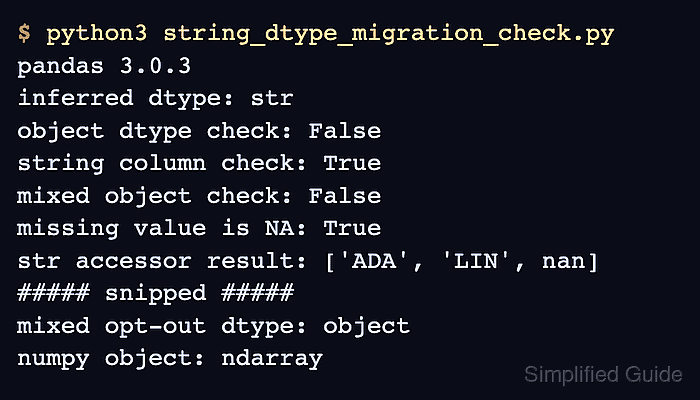
- Run the migration check script.
$ python3 string_dtype_migration_check.py
pandas 3.0.3
inferred dtype: str
object dtype check: False
string column check: True
mixed object check: False
missing value is None: False
missing value is NA: True
str accessor result: ['ADA', 'LIN', nan]
non-string write: Invalid value '2.5' for dtype 'str'. Value should be a string or missing value, got 'float' instead.
mixed opt-out dtype: object
mixed opt-out value: 2.5
values object: ArrowStringArray
numpy object: ndarray
- Remove the temporary check script after project tests cover the same cases.
$ rm string_dtype_migration_check.py

Mohd Shakir Zakaria is a cloud architect with deep roots in software development and open-source advocacy. Certified in AWS, Red Hat, VMware, ITIL, and Linux, he specializes in designing and managing robust cloud and on-premises infrastructures.


