Application code often needs named fields rather than an answer that must be parsed from free-form prose. LlamaIndex can bind an LLM response to a Pydantic model so routing, extraction, and agent logic receive a validated Python object.
The as_structured_llm() wrapper attaches the model class to an LLM. A completion then exposes the validated object through response.raw, while response.text remains the serialized response text.
A deterministic custom LLM keeps the schema handoff test independent of a provider key. The same TicketSummary model and wrapper apply to a provider-backed LLM; only the LLM construction changes.
Steps to return structured output in LlamaIndex:
- Install llama-index-core and Pydantic in the active Python environment.
$ python -m pip install llama-index-core pydantic
Collecting llama-index-core
##### snipped #####
Successfully installed llama-index-core-0.14.23
##### snipped #####
A provider-backed LLM also requires its integration package in the same environment.
Related: How to install LlamaIndex with pip - Create structured_output.py with the imports and ticket schema.
- structured_output.py
import json
from collections.abc import Generator
from typing import Any

from llama_index.core.llms import CompletionResponse, CustomLLM, LLMMetadata
from pydantic import BaseModel, Field


class TicketSummary(BaseModel):
    team: str = Field(description="Team that should handle the ticket")
    priority: str = Field(description="Routing priority")
    next_action: str = Field(description="Next action for the team")
- Add the deterministic ticket-routing LLM below TicketSummary.
class TicketRouterLLM(CustomLLM):
    @property
    def metadata(self) -> LLMMetadata:
        return LLMMetadata(model_name="ticket-router", is_chat_model=False)

    def complete(
        self, prompt: str, formatted: bool = False, **kwargs: Any
    ) -> CompletionResponse:
        if "duplicate invoice" not in prompt.lower():
            return CompletionResponse(
                text='{"team":"support","priority":"normal",'
                '"next_action":"review ticket"}'
            )
        return CompletionResponse(
            text='{"team":"billing","priority":"high",'
            '"next_action":"review duplicate invoice"}'
        )

    def stream_complete(
        self, prompt: str, formatted: bool = False, **kwargs: Any
    ) -> Generator[CompletionResponse, None, None]:
        yield self.complete(prompt, formatted=formatted, **kwargs)
The two prompt paths make the adapter deterministic while preserving an input-dependent result. A provider LLM replaces TicketRouterLLM in production.
- Add the structured completion call below TicketRouterLLM.
structured_llm = TicketRouterLLM().as_structured_llm(
    output_cls=TicketSummary
)
response = structured_llm.complete(
    "Route this ticket: customer reports duplicate invoice INV-1042."
)
ticket = response.raw
response.raw holds the validated TicketSummary instance. Invalid or missing fields cause Pydantic validation to fail instead of silently returning an incomplete object.
- Add type, field, and JSON checks below the completion call.
assert isinstance(ticket, TicketSummary)
assert ticket.team == "billing"
assert ticket.priority == "high"

print(f"structured_type={type(ticket).__name__}")
print(json.dumps(ticket.model_dump(), indent=2))
- Run the completed structured-output program.
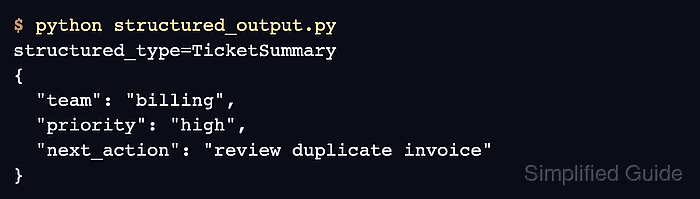
$ python structured_output.py
structured_type=TicketSummary
{
  "team": "billing",
  "priority": "high",
  "next_action": "review duplicate invoice"
}
The assertions stop execution when response.raw is not the expected model or when the routed fields differ from the requested ticket.

Mohd Shakir Zakaria is a cloud architect with deep roots in software development and open-source advocacy. Certified in AWS, Red Hat, VMware, ITIL, and Linux, he specializes in designing and managing robust cloud and on-premises infrastructures.


