Device names can move when storage order changes, but the filesystem UUID stays with the formatted volume. Reading that identifier before editing mounts, boot entries, or recovery notes keeps a Linux system pointed at the intended partition instead of whichever device name appears first.
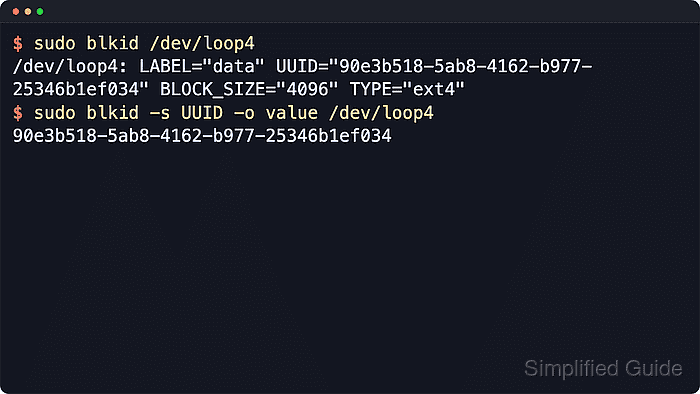
The UUID shown by lsblk and blkid is filesystem metadata. It is the value used by UUID=… entries in /etc/fstab, mount commands, and many installer or recovery tools. It is separate from PARTUUID, which comes from the partition table and is only the right value when the target configuration explicitly uses PARTUUID=….
Use the partition, logical volume, or mapped device that contains the filesystem, not the parent disk, unless the filesystem was created directly on that whole-disk node. A blank UUID usually means the selected node has no filesystem signature, the device is encrypted or layered below another mapped device, or the metadata is not visible to the running system.
Steps to get a disk or partition UUID in Linux:
- List filesystem identifiers for visible block devices.
$ lsblk --fs --list
NAME  FSTYPE FSVER LABEL UUID                                 FSAVAIL FSUSE% MOUNTPOINTS
sda
sda1  vfat   FAT32 EFI   35A7-16B2                             505M     1% /boot/efi
sda2  ext4   1.0   root  41c22818-fbad-4da6-8196-c816df0b7aa8   42G    38% /
sdb
sdb1  ext4   1.0   data  90e3b518-5ab8-4162-b977-25346b1ef034   56G    12% /mnt/data
The relevant row is the filesystem device, such as sdb1, nvme1n1p1, or a logical volume under /dev/mapper. Parent disks such as sdb often have no filesystem UUID.
- Read the exact filesystem metadata from the target device.
$ sudo blkid /dev/sdb1
/dev/sdb1: LABEL="data" UUID="90e3b518-5ab8-4162-b977-25346b1ef034" BLOCK_SIZE="4096" TYPE="ext4"
The UUID field is the filesystem identifier. If the target config uses PARTUUID=… instead, use the partition-table identifier from that same device only for that specific config.
- Print only the filesystem UUID when a configuration file or script needs the raw value.
$ sudo blkid -s UUID -o value /dev/sdb1
90e3b518-5ab8-4162-b977-25346b1ef034
If blkid prints no UUID, verify that the path points to the filesystem itself and not only to a whole-disk device that contains partitions.
- Confirm that a mounted filesystem with that UUID resolves to the expected device and its mount point.
$ findmnt --source UUID=90e3b518-5ab8-4162-b977-25346b1ef034 --output TARGET,SOURCE,FSTYPE,OPTIONS
TARGET    SOURCE     FSTYPE OPTIONS
/mnt/data /dev/sdb1  ext4   rw,relatime
findmnt searches mounted filesystems. It prints nothing for an unmounted volume even when blkid can read the filesystem UUID.