An agent can choose application actions only when each action has a clear name, typed inputs, and a result it can pass back to the model. LangChain represents that contract as a tool, keeping the callable behavior in Python while exposing only the fields the model needs.
The @tool decorator converts a function into a BaseTool object. A Pydantic model supplies field descriptions, defaults, and allowed values for the model-facing schema, while the decorator description explains when the action applies.
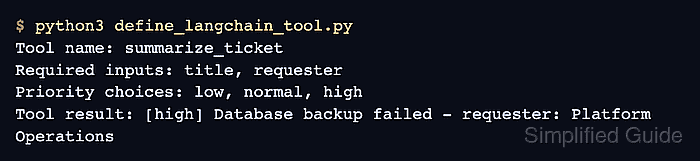
A direct invocation can validate the tool contract without an API key or agent loop. The completed program prints the exposed name and schema details, then calls the tool with a support-ticket payload so the returned value depends on the supplied inputs.
Steps to define a LangChain tool:
- Open an activated Python project environment that already contains LangChain.
- Start define_langchain_tool.py with the imports and Pydantic input schema.
- define_langchain_tool.py
from typing import Literal

from langchain.tools import tool
from pydantic import BaseModel, Field


class TicketSummaryInput(BaseModel):
    """Input fields for a support-ticket summary."""

    title: str = Field(description="Short title from the support queue")
    priority: Literal["low", "normal", "high"] = Field(
        default="normal",
        description="Escalation priority for the routing summary",
    )
    requester: str = Field(description="Name or team that opened the ticket")
- Add the decorated summarize_ticket() function below the input schema.
@tool(
    "summarize_ticket",
    args_schema=TicketSummaryInput,
    description="Create a routing summary for a support ticket.",
)
def summarize_ticket(
    title: str,
    requester: str,
    priority: str = "normal",
) -> str:
    return f"[{priority}] {title} - requester: {requester}"
snake_case tool names have broad provider compatibility. Side effects such as ticket updates or database writes still need narrow input schemas and application-level authorization checks.
- Append schema inspection and direct invocation below the tool function.
schema = summarize_ticket.tool_call_schema.model_json_schema()
print(f"Tool name: {summarize_ticket.name}")
print(f"Required inputs: {', '.join(schema['required'])}")
print(
    "Priority choices: "
    + ", ".join(schema["properties"]["priority"]["enum"])
)

result = summarize_ticket.invoke(
    {
        "title": "Database backup failed",
        "priority": "high",
        "requester": "Platform Operations",
    }
)
print(f"Tool result: {result}")
- Review the completed define_langchain_tool.py file before execution.
- define_langchain_tool.py
from typing import Literal

from langchain.tools import tool
from pydantic import BaseModel, Field


class TicketSummaryInput(BaseModel):
    """Input fields for a support-ticket summary."""

    title: str = Field(description="Short title from the support queue")
    priority: Literal["low", "normal", "high"] = Field(
        default="normal",
        description="Escalation priority for the routing summary",
    )
    requester: str = Field(description="Name or team that opened the ticket")


@tool(
    "summarize_ticket",
    args_schema=TicketSummaryInput,
    description="Create a routing summary for a support ticket.",
)
def summarize_ticket(
    title: str,
    requester: str,
    priority: str = "normal",
) -> str:
    return f"[{priority}] {title} - requester: {requester}"


schema = summarize_ticket.tool_call_schema.model_json_schema()
print(f"Tool name: {summarize_ticket.name}")
print(f"Required inputs: {', '.join(schema['required'])}")
print(
    "Priority choices: "
    + ", ".join(schema["properties"]["priority"]["enum"])
)

result = summarize_ticket.invoke(
    {
        "title": "Database backup failed",
        "priority": "high",
        "requester": "Platform Operations",
    }
)
print(f"Tool result: {result}")
- Run define_langchain_tool.py to confirm the exposed schema and callable result.
$ python3 define_langchain_tool.py
Tool name: summarize_ticket
Required inputs: title, requester
Priority choices: low, normal, high
Tool result: [high] Database backup failed - requester: Platform Operations

Mohd Shakir Zakaria is a cloud architect with deep roots in software development and open-source advocacy. Certified in AWS, Red Hat, VMware, ITIL, and Linux, he specializes in designing and managing robust cloud and on-premises infrastructures.


