Source NAT rewrites the source address on packets leaving a Linux gateway. With iptables, an SNAT rule gives a private subnet a specific outgoing address when the gateway has a static upstream address and policy needs to name that address directly.
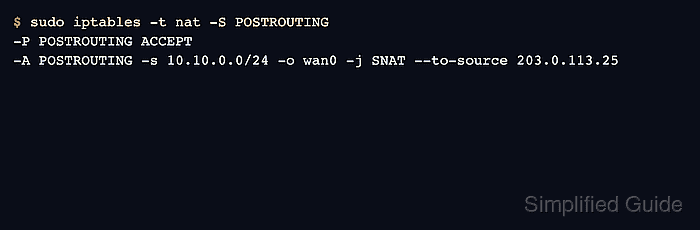
SNAT belongs in the nat table's POSTROUTING chain because the outgoing interface and route are known by then. The FORWARD chain still decides whether private clients may cross the gateway, so translation and forwarding rules must both be present.
Examples below use a private client subnet, an upstream interface, and a static translated source address. Use MASQUERADE instead of SNAT when the upstream address changes dynamically, and save rules only after a private client test and the POSTROUTING counter prove the rule matched.
Steps to configure SNAT with iptables:
- Identify the private and upstream interfaces on the gateway.
$ ip -br addr
lo               UNKNOWN        127.0.0.1/8 ::1/128
lan0             UP             10.10.0.1/24
wan0             UP             203.0.113.25/24
lan0 receives traffic from private clients. wan0 owns the static address used for translated outbound packets.
- Confirm the gateway has the intended static source address.
$ ip addr show dev wan0
3: wan0: <BROADCAST,MULTICAST,UP,LOWER_UP> mtu 1500
    inet 203.0.113.25/24 scope global wan0
SNAT should name an address that remains valid on the upstream path. Use MASQUERADE for DHCP, PPP, tunnel, or other changing upstream addresses.
- Enable IPv4 packet forwarding for the current runtime.
$ sudo sysctl -w net.ipv4.ip_forward=1
net.ipv4.ip_forward = 1
This immediately allows the host to route IPv4 packets between interfaces when firewall rules and routes permit it.
- Allow private clients to forward out through the upstream interface.
$ sudo iptables -A FORWARD -s 10.10.0.0/24 -o wan0 -j ACCEPT
- Allow established return traffic from upstream.
$ sudo iptables -A FORWARD -d 10.10.0.0/24 -i wan0 -m conntrack --ctstate ESTABLISHED,RELATED -j ACCEPT
Use stricter interface, destination, or service matches when the gateway policy requires them. A broad FORWARD allow is acceptable only when it matches the intended private subnet policy.
- Add the SNAT rule for the private subnet.
$ sudo iptables -t nat -A POSTROUTING -s 10.10.0.0/24 -o wan0 -j SNAT --to-source 203.0.113.25
SNAT names the translated source address explicitly. It differs from MASQUERADE, which uses the current address on the outgoing interface.
- Confirm the SNAT rule is present.
$ sudo iptables -t nat -S POSTROUTING
-P POSTROUTING ACCEPT
-A POSTROUTING -s 10.10.0.0/24 -o wan0 -j SNAT --to-source 203.0.113.25
- Confirm the forward rules are present.
$ sudo iptables -S FORWARD
-P FORWARD DROP
-A FORWARD -s 10.10.0.0/24 -o wan0 -j ACCEPT
-A FORWARD -d 10.10.0.0/24 -i wan0 -m conntrack --ctstate RELATED,ESTABLISHED -j ACCEPT
- Test outbound reachability from a private client.
$ curl -sS https://ifconfig.example.net/
203.0.113.25
Use a service that reports the observed source address, or verify the source on the upstream firewall logs. The reported address should match the SNAT address.
- Check the POSTROUTING counter after the client test.
$ sudo iptables -t nat --list POSTROUTING --line-numbers --numeric --verbose --exact
Chain POSTROUTING (policy ACCEPT 0 packets, 0 bytes)
num      pkts      bytes target     prot opt in     out     source               destination
1           6        504 SNAT       all  --  *      wan0    10.10.0.0/24         0.0.0.0/0            to:203.0.113.25
A zero counter after a successful client test usually means the client did not use this gateway, the source CIDR is wrong, or the outgoing interface name does not match the real route.
- Save the verified runtime rules through the host's persistence method.
$ sudo netfilter-persistent save
run-parts: executing /usr/share/netfilter-persistent/plugins.d/15-ip4tables save
Persist SNAT only after the private client test reports the intended translated address.
Related: How to save iptables rules permanently

Mohd Shakir Zakaria is a cloud architect with deep roots in software development and open-source advocacy. Certified in AWS, Red Hat, VMware, ITIL, and Linux, he specializes in designing and managing robust cloud and on-premises infrastructures.


