CentOS Stream and Red Hat Enterprise Linux (RHEL) servers often need AWS CLI before automation jobs can call S3, STS, or deployment APIs from the shell. Installing AWS CLI version 2 from the AWS Linux ZIP installer gives the host the current aws command without relying on RHEL-family repositories that can trail the upstream release.
AWS publishes separate Linux installers for x86_64 and aarch64 systems. The bundled install script copies the CLI under /usr/local/aws-cli and creates /usr/local/bin/aws by default, so the shell can find the command through the normal system PATH.
Minimal CentOS Stream and RHEL images usually already include curl through curl-minimal, but they may not include unzip, groff, or less. Use the installer archive that matches the CPU architecture, and use the installer --update option when replacing an existing manual AWS CLI v2 install in the same directory.
Related: How to check AWS CLI version
Related: How to configure AWS CLI on Linux and macOS
Related: How to install AWS CLI on Ubuntu
Related: Install AWS CLI version 1 using pip
Steps to install AWS CLI on CentOS Stream or Red Hat Enterprise Linux:
- Install the RHEL-family prerequisites.
$ sudo dnf install --assumeyes unzip groff less
unzip extracts the installer archive. groff and less support built-in AWS CLI help output on minimal hosts. If curl is missing on a stripped-down image, install the distribution's curl package before downloading the archive.
- Check the CPU architecture.
$ uname -m
x86_64
x86_64 uses the default download URL in the next step. Use the aarch64 archive on ARM64 systems.
- Download the current AWS CLI version 2 installer archive.
$ curl "https://awscli.amazonaws.com/awscli-exe-linux-x86_64.zip" -o "awscliv2.zip"
For aarch64 hosts, replace the URL with https://awscli.amazonaws.com/awscli-exe-linux-aarch64.zip.
- Extract the installer archive.
$ unzip awscliv2.zip
Archive:  awscliv2.zip
   creating: aws/
  inflating: aws/install
##### snipped #####
- Run the bundled installer with sudo.
$ sudo ./aws/install
You can now run: /usr/local/bin/aws --version
The default install directory is /usr/local/aws-cli and the default symlink path is /usr/local/bin/aws. For an existing manual AWS CLI v2 install, use sudo ./aws/install --bin-dir /usr/local/bin --install-dir /usr/local/aws-cli --update.
- Confirm that the shell resolves the bundled aws command.
$ command -v aws
/usr/local/bin/aws
If the shell still resolves /usr/bin/aws, an older distro package is taking precedence over the bundled install.
- Confirm that the active command reports AWS CLI v2.
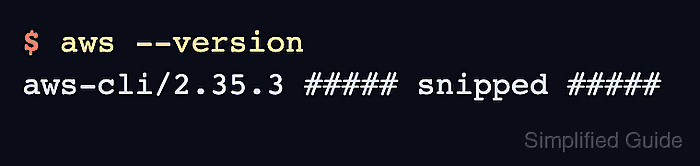
$ aws --version
aws-cli/2.35.3 ##### snipped #####
The exact version, bundled runtime, and platform string change over time. The decisive result is that the line starts with aws-cli/2.
Related: How to check AWS CLI version - Remove the downloaded installer files.
$ rm -r aws awscliv2.zip
Removing these temporary files does not uninstall AWS CLI from /usr/local/aws-cli.
- Run a signed identity check after credentials are configured.
$ aws sts get-caller-identity --query Account --output text
123456789012
Use aws configure, aws configure sso, or aws login before this step on a new host.
Related: How to configure AWS CLI on Linux and macOS
Related: How to log in to AWS CLI with IAM Identity Center
Related: How to check the current caller identity in AWS CLI

Mohd Shakir Zakaria is a cloud architect with deep roots in software development and open-source advocacy. Certified in AWS, Red Hat, VMware, ITIL, and Linux, he specializes in designing and managing robust cloud and on-premises infrastructures.


