How to one-hot encode categorical features with scikit-learn
Many scikit-learn estimators expect numeric feature matrices, while source tables often carry labels such as city and plan names. OneHotEncoder gives each learned category its own binary column without inventing an order between labels.
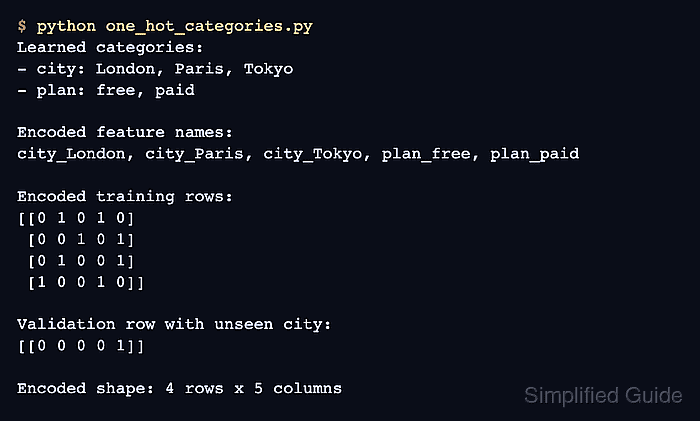
The encoder should learn categories from training rows only. Reuse that fitted object for validation and prediction data so output columns stay in the same order and held-out categories do not influence the model's feature space.
Setting handle_unknown="ignore" emits zeros for every output column belonging to an unseen category instead of raising an error. Setting sparse_output=False makes this small matrix readable, but high-cardinality production data normally benefits from the default sparse output.
Steps to one-hot encode categorical features with scikit-learn:
- Create one_hot_categories.py with the column names, training rows, and one new row.
- one_hot_categories.py
from sklearn.preprocessing import OneHotEncoder


feature_names = ["city", "plan"]
training_rows = [
    ["Paris", "free"],
    ["Tokyo", "paid"],
    ["Paris", "paid"],
    ["London", "free"],
]
new_rows = [["Berlin", "paid"]]
- Append the encoder fitting block below new_rows in one_hot_categories.py.
encoder = OneHotEncoder(handle_unknown="ignore", sparse_output=False)
encoded_training = encoder.fit_transform(training_rows).astype(int)
output_features = encoder.get_feature_names_out(feature_names)
- Append the final validation-report block below output_features in one_hot_categories.py.
encoded_new = encoder.transform(new_rows).astype(int)

print("Features:", ", ".join(output_features))
print("Training shape:", encoded_training.shape)
print("New row:", encoded_new)
assert encoded_new.tolist() == [[0, 0, 0, 0, 1]]
- Run one_hot_categories.py to verify the learned columns and unseen-category behavior.
$ python3 one_hot_categories.py
Features: city_London, city_Paris, city_Tokyo, plan_free, plan_paid
Training shape: (4, 5)
New row: [[0 0 0 0 1]]
The first three positions belong to the learned city categories, so the unseen Berlin value produces zeros there. The final 1 belongs to plan_paid, which was learned from the training rows.