How to resolve a hostname to IP addresses in PHP
Hostnames can publish both IPv4 and IPv6 addresses as DNS resource records. PHP can query those records directly while keeping the address families distinguishable for application-specific handling.
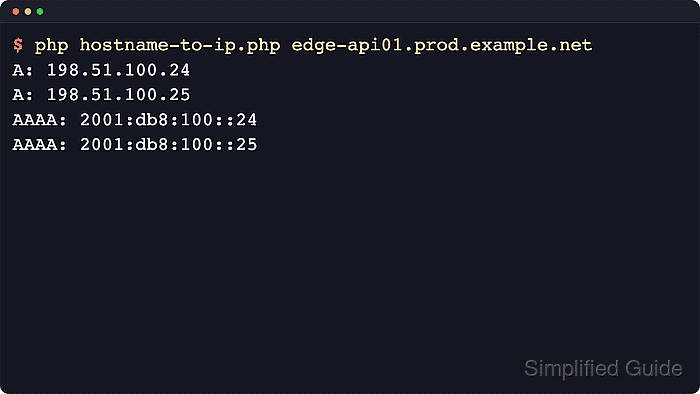
The dns_get_record() function returns structured resource-record rows. Limiting the request to DNS_A and DNS_AAAA avoids unrelated records while exposing IPv4 values through the ip field and IPv6 values through ipv6.
DNS answers are snapshots rather than permanent mappings. Authoritative record changes and cached record lifetimes can change the returned set over time, so use a fully qualified hostname and handle an empty answer explicitly.
Related: Get a hostname from a URL using PHP
Tool: DNS Record Lookup
Steps to resolve a hostname to IP addresses in PHP:
- Create hostname-to-ip.php with a resolver function that requests A and AAAA records and rejects a failed DNS query.
- hostname-to-ip.php
<?php
function resolveHostnameToAddresses(string $hostname): array
{
    $records = dns_get_record($hostname, DNS_A | DNS_AAAA);

    if ($records === false) {
        throw new RuntimeException("DNS query failed for {$hostname}");
    }

    $addresses = [];

    return $addresses;
}
dns_get_record() uses the resolver available to the running PHP process. It does not query an arbitrary name server selected by the script.
- Replace the final return statement in resolveHostnameToAddresses() with address normalization and an empty-answer check.
foreach ($records as $record) {
    if ($record['type'] === 'A' && isset($record['ip'])) {
        $addresses[] = [
            'type' => 'A',
            'address' => $record['ip'],
        ];
    }

    if ($record['type'] === 'AAAA' && isset($record['ipv6'])) {
        $addresses[] = [
            'type' => 'AAAA',
            'address' => $record['ipv6'],
        ];
    }
}

if ($addresses === []) {
    throw new RuntimeException("No A or AAAA records found for {$hostname}");
}

return $addresses;
The record type selects the matching address field. An A row uses ip, while an AAAA row uses ipv6.
- Append command-line input handling and labeled address output after the resolver function.
$hostname = trim($argv[1] ?? '');

if ($hostname === '') {
    fwrite(STDERR, "Usage: {$argv[0]} <hostname>" . PHP_EOL);
    exit(1);
}

try {
    $addresses = resolveHostnameToAddresses($hostname);
} catch (RuntimeException $exception) {
    fwrite(STDERR, $exception->getMessage() . PHP_EOL);
    exit(1);
}

foreach ($addresses as $entry) {
    echo $entry['type'], ': ', $entry['address'], PHP_EOL;
}
The record label preserves the address family until the caller applies an IPv4 or IPv6 connection policy. DNS answer order is not an application preference rule.
- Run the script with a reserved invalid hostname to confirm that an empty address set exits with an error.
$ php hostname-to-ip.php missing-host.invalid.
No A or AAAA records found for missing-host.invalid.
The trailing dot makes the test name absolute, so a local DNS search suffix cannot extend it.
- Run the completed script with iana.org to resolve its available address families.
$ php hostname-to-ip.php iana.org
A: 192.0.43.8
AAAA: 2001:500:88:200::8
The exact records and their order can change when the authoritative zone or resolver cache changes.