How to generate structured output with the Ollama API
Structured output constrains an Ollama response to JSON or a JSON schema so application code can parse fields instead of scraping prose. It is useful for classification, extraction, routing, and any workflow where free-form text would create fragile downstream logic.
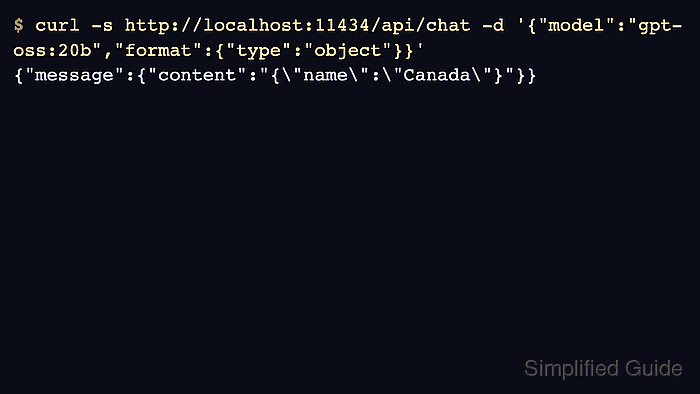
The format field can request generic JSON or provide a schema object. Pair the schema with a direct prompt and deterministic options when the result will be validated automatically.
The local fixture confirmed schema-shaped output with gpt-oss:20b. The same pattern works through api/chat and can be adapted to SDK calls that pass an equivalent schema.
Steps to generate structured output with the Ollama API:
- Write the JSON schema that the response must match.
{ "type": "object", "properties": { "name": {"type": "string"}, "capital": {"type": "string"} }, "required": ["name", "capital"] } - Send the schema in the format field of a chat request.
$ curl -s http://localhost:11434/api/chat -d '{
  "model": "gpt-oss:20b",
  "messages": [{"role":"user","content":"Return a JSON object for Canada with keys name and capital."}],
  "stream": false,
  "format": {
    "type":"object",
    "properties":{"name":{"type":"string"},"capital":{"type":"string"}},
    "required":["name","capital"]
  },
  "options": {"temperature": 0}
}'
{"message":{"content":"{\"name\":\"Canada\",\"capital\":\"Ottawa\"}"},"done":true}
- Parse and validate the returned content before using it.
$ python3 - <<'PY' import json content = '{"name":"Canada","capital":"Ottawa"}' obj = json.loads(content) assert set(["name", "capital"]).issubset(obj) print(obj["capital"]) PY Ottawa - Keep reasoning fields separate from the structured content when using thinking models.
$ jq '.message.content' response.json
"{\"name\":\"Canada\",\"capital\":\"Ottawa\"}"
Do not parse message.thinking as application data.
- Reject malformed or missing fields in the caller.
$ python3 - <<'PY'
import json
required = {"name", "capital"}
obj = json.loads('{"name":"Canada"}')
print(required <= obj.keys())
PY
False