How to multiply matrices with NumPy
Matrix multiplication combines rows and columns into weighted totals, which makes it a core operation in coordinate transforms, linear models, and equation systems. NumPy performs this calculation directly on regular arrays without manual nested loops.
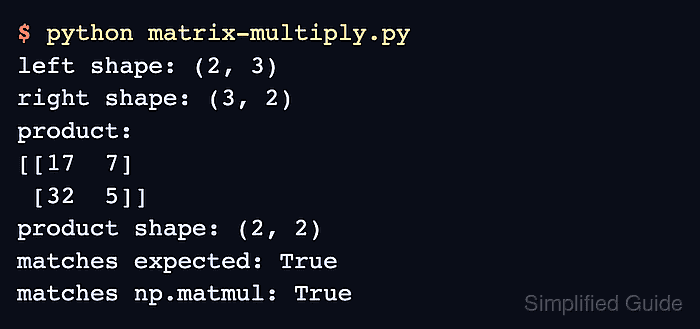
For two-dimensional arrays, the left matrix shape (n, k) and right matrix shape (k, m) produce a result shaped (n, m). The shared inner dimension must match because each left row is paired with every right column.
The @ operator is the clearest form for two-dimensional matrix products and has the same semantics as np.matmul(). Keep * and np.multiply() for element-wise multiplication, and use ordinary ndarray values because the older numpy.matrix class is no longer recommended.
Related: Transpose an array
Related: Solve linear equations
Related: Calculate with broadcasting
Steps to multiply matrices with NumPy:
- Create matrix-multiply.py with NumPy and two compatible operand arrays.
- matrix-multiply.py
import numpy as np

left = np.array(
    [
        [2, 1, 3],
        [0, 4, 5],
    ]
)
right = np.array(
    [
        [1, 2],
        [3, 0],
        [4, 1],
    ]
)
The left matrix has three columns and the right matrix has three rows, so their shared inner dimension is compatible.
- Insert an inner-dimension check below the right array definition.
if left.shape[1] != right.shape[0]:
    message = (
        f"left shape {left.shape} is incompatible "
        f"with right shape {right.shape}"
    )
    raise ValueError(message)
This check reports the actual shapes before @ raises a lower-level dimension error, which is helpful when operands come from files or earlier transforms.
- Append the matrix product and expected-result checks to matrix-multiply.py.
product = left @ right
expected = np.array(
    [
        [17, 7],
        [32, 5],
    ]
)

np.testing.assert_array_equal(product, expected)
assert product.shape == (2, 2)

print("product:")
print(product)
print("shape:", product.shape)
print("matches expected:", np.array_equal(product, expected))
- Run the completed matrix multiplication script.
$ python3 matrix-multiply.py
product:
[[17  7]
 [32  5]]
shape: (2, 2)
matches expected: True
The command exits with an assertion error if either the values or the (2, 2) result shape differs from the expected matrix.