How to concatenate NumPy arrays
Arrays in NumPy often arrive as matching blocks, such as monthly rows, feature columns, or batches from separate files. Concatenation joins those blocks along an axis that already exists so later calculations can work with one array.
The selected axis is the dimension that grows. For a two-dimensional array, axis=0 adds rows while preserving the column count, and axis=1 adds columns while preserving the row count.
Dimensions outside the join axis must match exactly for np.concatenate(). np.stack() keeps each input as a separate layer by adding a new axis, while axis=None makes NumPy flatten every input before joining.
Related: Stack arrays
Related: Create an array
Related: Reshape an array
Steps to concatenate NumPy arrays:
- Define the compatible input arrays in array-concatenate.py.
- array-concatenate.py
import numpy as np

north = np.array([[10, 11, 12], [13, 14, 15]])
south = np.array([[20, 21, 22]])
east = np.array([[30], [31]])
south has the same three-column width as north, while east has the same two-row height.
- Add the row concatenation and its expected-value assertion below the input arrays.
by_row = np.concatenate((north, south), axis=0)
expected_by_row = np.array([[10, 11, 12], [13, 14, 15], [20, 21, 22]])
np.testing.assert_array_equal(by_row, expected_by_row)
axis=0 grows the first dimension from two rows to three while retaining all three columns.
- Append the column concatenation and its expected-value assertion after the row assertion.
by_column = np.concatenate((north, east), axis=1)
expected_by_column = np.array([[10, 11, 12, 30], [13, 14, 15, 31]])
np.testing.assert_array_equal(by_column, expected_by_column)
axis=1 grows the second dimension from three columns to four while retaining both rows.
- Add the shape and value reporting section after both assertions.
print("north shape:", north.shape)
print("south shape:", south.shape)
print("east shape:", east.shape)
print("by row:")
for row in by_row:
    print(" ", row.tolist())
print("by row shape:", by_row.shape)
print("by column:")
for row in by_column:
    print(" ", row.tolist())
print("by column shape:", by_column.shape)
- Consolidate the sections into the completed array-concatenate.py file.
- array-concatenate.py
import numpy as np

north = np.array([[10, 11, 12], [13, 14, 15]])
south = np.array([[20, 21, 22]])
east = np.array([[30], [31]])

by_row = np.concatenate((north, south), axis=0)
expected_by_row = np.array([[10, 11, 12], [13, 14, 15], [20, 21, 22]])
np.testing.assert_array_equal(by_row, expected_by_row)

by_column = np.concatenate((north, east), axis=1)
expected_by_column = np.array([[10, 11, 12, 30], [13, 14, 15, 31]])
np.testing.assert_array_equal(by_column, expected_by_column)

print("north shape:", north.shape)
print("south shape:", south.shape)
print("east shape:", east.shape)
print("by row:")
for row in by_row:
    print(" ", row.tolist())
print("by row shape:", by_row.shape)
print("by column:")
for row in by_column:
    print(" ", row.tolist())
print("by column shape:", by_column.shape)
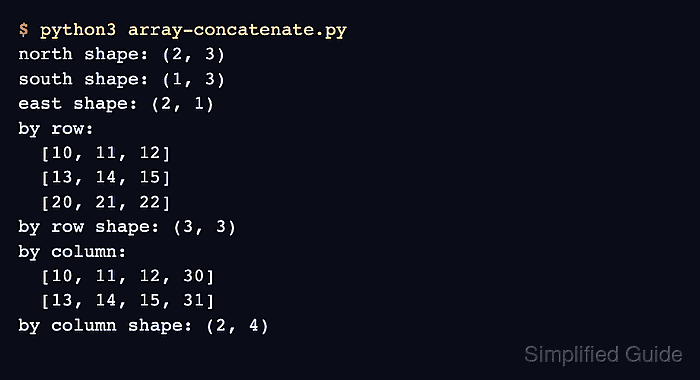
- Run the completed script to verify both concatenated arrays and shapes.
$ python3 array-concatenate.py
north shape: (2, 3)
south shape: (1, 3)
east shape: (2, 1)
by row:
  [10, 11, 12]
  [13, 14, 15]
  [20, 21, 22]
by row shape: (3, 3)
by column:
  [10, 11, 12, 30]
  [13, 14, 15, 31]
by column shape: (2, 4)
The output keeps rank 2 in both joins. The row join becomes (3, 3), and the column join becomes (2, 4).