How to view processes by user in Linux
Shared Linux hosts often run login shells, service workers, scheduled jobs, and deployment tasks under different accounts. Viewing only one user's processes narrows a crowded process table to the account responsible for the work being checked.
The ps command reads the process table exposed through /proc and can select rows by user name or numeric user ID. The -u selector matches the effective user, which is the identity used for most permission checks, while -U matches the real user that started the process.
Most ordinary processes have the same real and effective user, so ps -u is usually enough for service accounts and login users. On systems where /proc visibility is restricted, an unprivileged account may see fewer details for other users' processes, and a header-only result means no matching process is visible in that shell context.
Related: How to view active processes in Linux
Related: How to kill a process in Linux
Steps to view Linux processes by user:
- Confirm the target account name.
$ id appuser
uid=1001(appuser) gid=1001(appuser) groups=1001(appuser)
Replace appuser with the login or service account being inspected.
- List processes whose effective user is the target account.
$ ps -u appuser -f
UID          PID    PPID  C STIME TTY          TIME CMD
appuser       53      49  0 20:57 ?        00:00:00 sleep 600
appuser       55      50  0 20:57 ?        00:00:00 sleep 600
-u selects by effective user name or ID. Use sudo ps -u appuser -f only when local /proc permissions hide process details needed for administration.
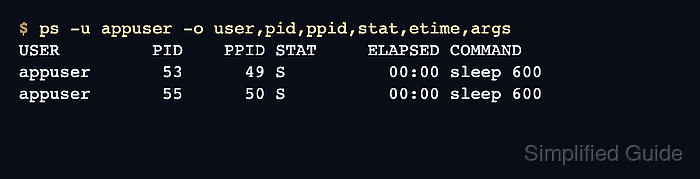
- Print a compact handoff view with the owner, PID, parent PID, state, elapsed time, and command line.
$ ps -u appuser -o user,pid,ppid,stat,etime,args
USER         PID    PPID STAT     ELAPSED COMMAND
appuser       53      49 S          00:00 sleep 600
appuser       55      50 S          00:00 sleep 600
The STAT column shows the process state, and ELAPSED shows how long the process has existed.
- Include both real-user and effective-user matches when set-user-ID behavior or privilege changes matter.
$ ps -U appuser -u appuser -o ruser,euser,pid,stat,args
RUSER    EUSER        PID STAT COMMAND
appuser  appuser       53 S    sleep 600
appuser  appuser       55 S    sleep 600
-U selects the real user, and -u selects the effective user. ps selection options are additive, so this form includes processes that match either selector.
- Compare two accounts in one process listing when ownership is being handed off or split between services.
$ ps -u appuser,deploy -o user,pid,stat,args
USER         PID STAT COMMAND
appuser       53 S    sleep 600
deploy        54 S    sleep 600
appuser       55 S    sleep 600
Separate user names or numeric IDs with commas when more than one account should appear in the same output.
- Check the empty-match case for a user with no visible processes.
$ ps -u nobody -o user,pid,args
USER         PID COMMAND
A header with no process rows means no process matched that selector in the current view. Recheck the account name with id when the result is unexpected.