How to evaluate a Keras binary classifier with a confusion matrix
Aggregate accuracy can hide whether a binary classifier misses positive cases or raises false alarms on negative cases. A confusion matrix separates those errors into true-negative, false-positive, false-negative, and true-positive counts for the same holdout set used by Keras evaluation.
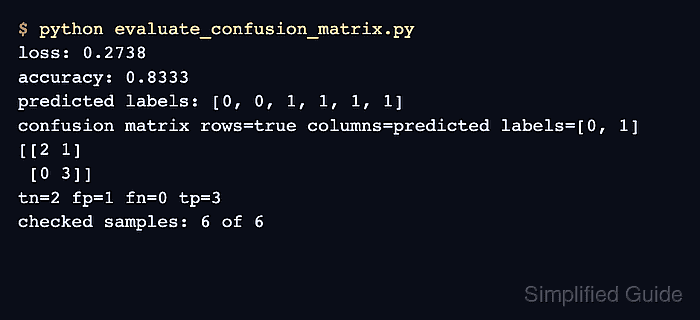
The saved model, /x-test.npy features, and /y-test.npy labels must use the same preprocessing and sample order. The script loads the model without its training configuration, then compiles it with binary cross-entropy and accuracy so the evaluation settings remain explicit; projects that used another binary loss or metric should use that matching configuration.
The binary evaluation assumes integer labels 0 and 1 plus one sigmoid score per sample, with 0.5 as the class threshold. Rows represent true labels and columns represent predicted labels; a fixed labels=[0, 1] order lets the custom matrix be checked against scikit-learn without changing cell positions. Multiclass softmax output needs argmax(axis=1) and a larger matrix instead.
Steps to evaluate a Keras binary classifier with a confusion matrix:
- Create /evaluate_confusion_matrix.py with the model, evaluation configuration, and holdout arrays.
- evaluate_confusion_matrix.py
import keras
import numpy as np
from sklearn.metrics import confusion_matrix

model = keras.saving.load_model("classifier.keras", compile=False)
model.compile(optimizer="adam", loss="binary_crossentropy", metrics=["accuracy"])
x_test = np.load("x-test.npy")
y_test = np.load("y-test.npy").astype("int32").reshape(-1)
The filenames and evaluation configuration must match the saved classifier and its holdout data.
- Append the evaluation and threshold conversion below the holdout array loading code.
metrics = model.evaluate(x_test, y_test, verbose=0, return_dict=True)
probabilities = model.predict(x_test, verbose=0).reshape(-1)
y_pred = (probabilities >= 0.5).astype("int32")
- Append the matrix accumulation below the predicted-label conversion.
matrix = np.zeros((2, 2), dtype="int32")
np.add.at(matrix, (y_test, y_pred), 1)
tn, fp, fn, tp = matrix.ravel()
- Append the independent reference check and reporting block below the matrix unpacking.
reference_matrix = confusion_matrix(y_test, y_pred, labels=[0, 1])
matches_reference = np.array_equal(matrix, reference_matrix)

print(f"loss: {metrics['loss']:.4f}")
print(f"accuracy: {metrics['accuracy']:.4f}")
print("confusion matrix rows=true columns=predicted labels=[0, 1]")
print(matrix)
print(f"tn={tn} fp={fp} fn={fn} tp={tp}")
print(f"matches sklearn reference: {matches_reference}")

if not matches_reference:
    raise RuntimeError("custom matrix differs from sklearn reference")
- Compare the assembled script with this complete file.
- evaluate_confusion_matrix.py
import keras
import numpy as np
from sklearn.metrics import confusion_matrix

model = keras.saving.load_model("classifier.keras", compile=False)
model.compile(optimizer="adam", loss="binary_crossentropy", metrics=["accuracy"])
x_test = np.load("x-test.npy")
y_test = np.load("y-test.npy").astype("int32").reshape(-1)

metrics = model.evaluate(x_test, y_test, verbose=0, return_dict=True)
probabilities = model.predict(x_test, verbose=0).reshape(-1)
y_pred = (probabilities >= 0.5).astype("int32")

matrix = np.zeros((2, 2), dtype="int32")
np.add.at(matrix, (y_test, y_pred), 1)
tn, fp, fn, tp = matrix.ravel()
reference_matrix = confusion_matrix(y_test, y_pred, labels=[0, 1])
matches_reference = np.array_equal(matrix, reference_matrix)

print(f"loss: {metrics['loss']:.4f}")
print(f"accuracy: {metrics['accuracy']:.4f}")
print("confusion matrix rows=true columns=predicted labels=[0, 1]")
print(matrix)
print(f"tn={tn} fp={fp} fn={fn} tp={tp}")
print(f"matches sklearn reference: {matches_reference}")

if not matches_reference:
    raise RuntimeError("custom matrix differs from sklearn reference")
- Run the completed evaluation script beside the saved model and holdout arrays.
$ python evaluate_confusion_matrix.py
loss: 0.4488
accuracy: 0.6667
confusion matrix rows=true columns=predicted labels=[0, 1]
[[2 1]
 [1 2]]
tn=2 fp=1 fn=1 tp=2
matches sklearn reference: True
- Read the matrix rows as true labels and columns as predicted labels.
The displayed matrix contains two true negatives, one false positive, one false negative, and two true positives.
- Confirm that the custom matrix matches the scikit-learn reference matrix for the fixed label order.
A False result raises an error because the custom accumulation no longer agrees with the independent reference implementation.