How to run hyperparameter tuning in Keras
Hyperparameter tuning tests several model configurations against the same validation signal before committing to a final training run. In Keras projects, KerasTuner can drive that search while the model-building function stays close to normal Keras code.
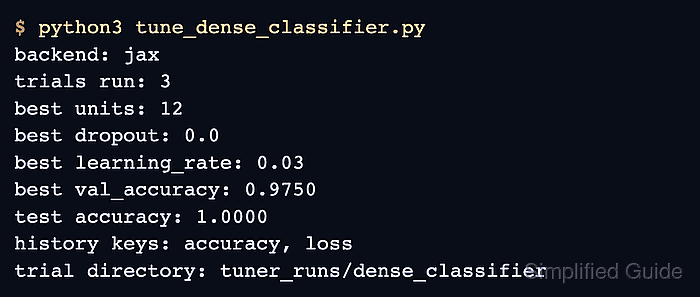
A bounded RandomSearch is enough for a local tuning smoke test. It samples a few values for hidden units, dropout, and learning rate, writes each trial under a project directory, and ranks the trials by val_accuracy.
The script selects the JAX backend before importing Keras so the run does not depend on TensorFlow in a minimal environment. Replace the synthetic arrays with project training and validation splits, keep the held-out test split separate, and raise max_trials only after the script records the expected trial files.
Related: How to install Keras with pip
Related: How to set the Keras backend
Related: How to compile a model in Keras
Steps to run Keras hyperparameter tuning:
- Save the backend selection, imports, and data split as
tune_dense_classifier.py
.
- tune_dense_classifier.py
import os
from pathlib import Path

os.environ["KERAS_BACKEND"] = "jax"

import keras
import keras_tuner
import numpy as np


keras.utils.set_random_seed(17)

rng = np.random.default_rng(17)
x = rng.normal(size=(240, 4)).astype("float32")
y = (
    (0.8 * x[:, 0] - 0.4 * x[:, 1] + 0.3 * x[:, 2] + 0.1 * x[:, 3]) > 0
).astype("float32")

x_train, x_val, x_test = x[:160], x[160:200], x[200:]
y_train, y_val, y_test = y[:160], y[160:200], y[200:]
Install Keras, KerasTuner, NumPy, and the selected backend in the same Python environment before running the script. Put the backend setting before any keras or keras_tuner import.
Related: How to set the Keras backend - Add the model-building function below the data split.
def build_model(hp):
    units = hp.Int("units", min_value=4, max_value=16, step=4)
    dropout = hp.Choice("dropout", values=[0.0, 0.2])
    learning_rate = hp.Choice("learning_rate", values=[0.01, 0.03])

    model = keras.Sequential(
        [
            keras.layers.Input(shape=(4,)),
            keras.layers.Dense(units, activation="relu"),
            keras.layers.Dropout(dropout),
            keras.layers.Dense(1, activation="sigmoid"),
        ]
    )
    model.compile(
        optimizer=keras.optimizers.Adam(learning_rate=learning_rate),
        loss=keras.losses.BinaryCrossentropy(),
        metrics=[keras.metrics.BinaryAccuracy(name="accuracy")],
        jit_compile=False,
    )
    return model
hp.Int() and hp.Choice() define the values KerasTuner can sample for each trial. Disable jit_compile for a short CPU smoke test if backend compilation time would hide the tuning result.
Related: How to compile a model in Keras
Related: How to disable JIT compilation in Keras - Add the RandomSearch tuner and the bounded search call.
tuner = keras_tuner.RandomSearch(
    build_model,
    objective="val_accuracy",
    max_trials=3,
    seed=17,
    overwrite=True,
    directory="tuner_runs",
    project_name="dense_classifier",
)

tuner.search(
    x_train,
    y_train,
    validation_data=(x_val, y_val),
    epochs=4,
    batch_size=16,
    verbose=0,
)
overwrite=True starts a fresh demo run when the same directory already exists. Remove it when a real tuning job should resume or preserve earlier trials.
- Add best-trial retrieval, final fitting, evaluation, and printed checks.
best_hp = tuner.get_best_hyperparameters(num_trials=1)[0]
best_trial = tuner.oracle.get_best_trials(num_trials=1)[0]

best_model = tuner.hypermodel.build(best_hp)
x_final = np.concatenate([x_train, x_val])
y_final = np.concatenate([y_train, y_val])
history = best_model.fit(x_final, y_final, epochs=4, batch_size=16, verbose=0)
_, accuracy = best_model.evaluate(x_test, y_test, verbose=0)

print(f"backend: {keras.config.backend()}")
print(f"trials run: {len(tuner.oracle.trials)}")
print(f"best units: {best_hp.get('units')}")
print(f"best dropout: {best_hp.get('dropout')}")
print(f"best learning_rate: {best_hp.get('learning_rate')}")
print(f"best val_accuracy: {best_trial.score:.4f}")
print(f"test accuracy: {accuracy:.4f}")
print(f"history keys: {', '.join(sorted(history.history.keys()))}")
print(f"trial directory: {Path('tuner_runs/dense_classifier').as_posix()}")
Rebuilding the model from best_hp keeps the final fit separate from the validation trials. Keep a test split outside the tuner search so the final metric is not part of trial selection.
- Run the tuning script.
$ python3 tune_dense_classifier.py
backend: jax
trials run: 3
best units: 12
best dropout: 0.0
best learning_rate: 0.03
best val_accuracy: 0.9750
test accuracy: 1.0000
history keys: accuracy, loss
trial directory: tuner_runs/dense_classifier
- Check the generated tuner directory.
$ ls tuner_runs/dense_classifier
oracle.json
trial_0
trial_1
trial_2
tuner0.json
Each trial_* directory stores the sampled hyperparameters and checkpoint files for one configuration. Keep this directory with experiment artifacts when the tuning results need to be reviewed later.