Local semantic search depends on two compatible pieces: dense vectors that capture text meaning and an index that can rank those vectors for each query. Sentence Transformers produces the embeddings, while FAISS provides an in-process search index that can be saved and loaded without a separate vector database service.
The corpus uses sentence-transformers/all-MiniLM-L6-v2 with an exact IndexFlatIP index. Normalizing document and query embeddings makes inner-product ranking equivalent to cosine-similarity ranking; IndexFlatIP still scans every stored vector, so larger collections may need an approximate FAISS index instead.
Flat indexes return sequential row numbers rather than application records. A JSON sidecar kept in the same order as the indexed vectors maps each result back to its document ID and text, and a row-count check stops the search when the saved index and metadata no longer agree.
Steps to build a FAISS index with Sentence Transformers:
- Install Sentence Transformers and the CPU build of FAISS in the active Python environment.
$ python -m pip install --upgrade sentence-transformers faiss-cpu
- Create build_faiss_index.py with the imports and ordered corpus records.
- build_faiss_index.py
import json
from pathlib import Path

import faiss
import numpy as np
from sentence_transformers import SentenceTransformer


corpus = [
    {
        "id": "doc-001",
        "text": "Sentence Transformers converts text into dense embeddings.",
    },
    {
        "id": "doc-002",
        "text": "FAISS stores vectors and searches nearest neighbors locally.",
    },
    {
        "id": "doc-003",
        "text": "Cross-encoders rerank a small set of retrieved passages.",
    },
    {
        "id": "doc-004",
        "text": "Qdrant stores vectors behind a database service API.",
    },
]
- Append the normalized document-embedding and exact-index section to build_faiss_index.py.
model = SentenceTransformer("sentence-transformers/all-MiniLM-L6-v2")
texts = [item["text"] for item in corpus]
document_embeddings = model.encode_document(
    texts,
    normalize_embeddings=True,
    convert_to_numpy=True,
)
document_embeddings = np.asarray(document_embeddings, dtype="float32")

dimension = document_embeddings.shape[1]
index = faiss.IndexFlatIP(dimension)
index.add(document_embeddings)
encode_document() preserves the document route or prompt defined by retrieval models that distinguish corpus text from queries.
- Append the index and metadata persistence section to build_faiss_index.py.
faiss.write_index(index, "support-faq.faiss")
Path("support-faq.json").write_text(
    json.dumps(corpus, indent=2),
    encoding="utf-8",
)
- Append the persisted-index search section to build_faiss_index.py.
loaded_index = faiss.read_index("support-faq.faiss")
metadata = json.loads(Path("support-faq.json").read_text(encoding="utf-8"))
if loaded_index.ntotal != len(metadata):
    raise RuntimeError("FAISS rows and metadata rows do not match")

query_embedding = model.encode_query(
    ["Which library searches vectors nearest neighbors locally?"],
    normalize_embeddings=True,
    convert_to_numpy=True,
)
query_embedding = np.asarray(query_embedding, dtype="float32")
scores, row_ids = loaded_index.search(query_embedding, k=2)

print(f"embedding dimension: {dimension}")
print(f"indexed vectors: {loaded_index.ntotal}")
print("top matches:")
for rank, (score, row_id) in enumerate(zip(scores[0], row_ids[0]), start=1):
    record = metadata[int(row_id)]
    print(f"{rank}. {record['id']} score={score:.4f} text={record['text']}")
encode_query() applies the matching query route or prompt before FAISS searches the reloaded index.
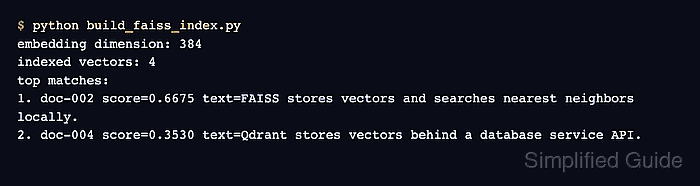
- Run build_faiss_index.py to build the searchable index.
$ python build_faiss_index.py
embedding dimension: 384
indexed vectors: 4
top matches:
1. doc-002 score=0.6675 text=FAISS stores vectors and searches nearest neighbors locally.
2. doc-004 score=0.3530 text=Qdrant stores vectors behind a database service API.
The first run may download the embedding model before the search output appears.

Mohd Shakir Zakaria is a cloud architect with deep roots in software development and open-source advocacy. Certified in AWS, Red Hat, VMware, ITIL, and Linux, he specializes in designing and managing robust cloud and on-premises infrastructures.


