A missing path in an rsync preview can come from a rule that matched the path itself or from an earlier rule that stopped traversal at one of its parent directories. FILTER debug messages name the sender-side match, so the first wrong decision can be corrected without running a live transfer.
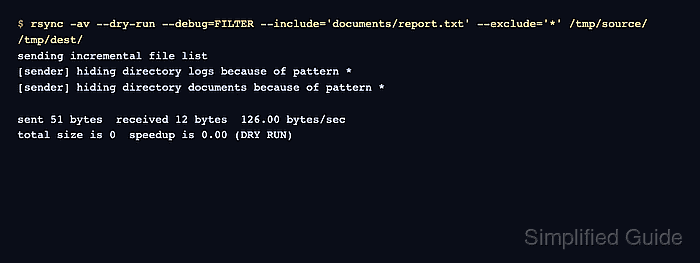
Filter order matters because rsync stops at the first matching include or exclude rule for each name. An include for /documents/report.txt cannot rescue the file after * has already hidden /documents/, so every parent directory that must be scanned needs an earlier include.
Run the diagnostic against the same source, destination, and ordered rules planned for the transfer. Use --debug=FILTER when the source is local or on a remote push; use -M--debug=FILTER for a remote pull so the option reaches the remote sender.
Steps to debug rsync filter rules:
- Reproduce the wrong file list with filter debugging and a dry run.
$ rsync -a --dry-run --debug=FILTER --include='/documents/report.txt' --exclude='*' source/ destination/
[sender] hiding directory data because of pattern *
[sender] hiding directory documents because of pattern *
Use the exact paths and filter order from the planned transfer. For a remote pull, replace --debug=FILTER with -M--debug=FILTER because the remote source is the sender.
- Follow the first unexpected match for the missing branch.
The trace says * hid the documents directory. Rsync therefore did not enter that directory and never evaluated the later file include for documents/report.txt.
- Insert an include for the parent directory before the file include and final catch-all rule, then repeat the debug dry run.
$ rsync -a --dry-run --debug=FILTER --include='/documents/' --include='/documents/report.txt' --exclude='*' source/ destination/
[sender] hiding directory data because of pattern *
[sender] showing directory documents because of pattern /documents/
[sender] hiding file documents/notes.txt because of pattern *
[sender] showing file documents/report.txt because of pattern /documents/report.txt
[sender] hiding file documents/report-hardlink.txt because of pattern *
The leading slash anchors both include patterns at the transfer root. The trailing slash on /documents/ limits that rule to the directory.
- Check that every unexpected hiding or showing line now names the intended rule.
Keep rules from --filter, --include-from, and --exclude-from in their original relative order while diagnosing a real command because all of them join the same ordered filter list.
- Remove filter debugging but keep the corrected rules and dry run for the final preview.
$ rsync -av --dry-run --include='/documents/' --include='/documents/report.txt' --exclude='*' source/ destination/
sending incremental file list
./
documents/
documents/report.txt

sent 121 bytes  received 26 bytes  294.00 bytes/sec
total size is 28  speedup is 0.19 (DRY RUN)
If the live command includes --delete, do not remove --dry-run until this final list contains only the paths that should be transferred or deleted. Changing filters can also change which destination files are protected from deletion.

Mohd Shakir Zakaria is a cloud architect with deep roots in software development and open-source advocacy. Certified in AWS, Red Hat, VMware, ITIL, and Linux, he specializes in designing and managing robust cloud and on-premises infrastructures.


