A training run can cross from valid arithmetic into NaN or infinity in a single operation, while later batches only repeat the damage. The useful boundary is the last finite tensor before the first non-finite loss or gradient, because that boundary narrows the fault to one part of the forward or backward pass.
The torch.isfinite function checks tensors directly, and autograd anomaly detection traces a failing backward operation to the forward call that created it. Anomaly detection adds runtime overhead, so it belongs in a short debug run rather than the normal training loop.
The CPU sample uses negative predictions with torch.sqrt to reproduce a non-finite loss without private data or GPU state. Its guards sit immediately after the model output, after the loss calculation, and after backward(); those are the same boundaries to keep when adapting the pattern to a failing batch.
Related: How to run a training loop in PyTorch
Related: How to clip gradients in PyTorch
Steps to debug PyTorch NaN loss:
- Create /debug_nan_loss.py with a finite-tensor guard.
- debug_nan_loss.py
import argparse

import torch
from torch import nn


def check_finite(name: str, tensor: torch.Tensor, *, step: int) -> None:
    finite = torch.isfinite(tensor)
    if bool(finite.all()):
        return

    values = tensor.detach()[~finite].flatten()[:4].tolist()
    print(f"non_finite={name}")
    print(f"step={step} shape={tuple(tensor.shape)} dtype={tensor.dtype}")
    print(f"values={values}")
    raise SystemExit(1)
The guard exits at the first NaN, positive infinity, or negative infinity instead of allowing the optimizer to update parameters from invalid values.
- Add a gradient guard below check_finite.
def check_gradients(model: nn.Module, *, step: int) -> None:
    for name, parameter in model.named_parameters():
        if parameter.grad is not None:
            check_finite(f"gradient:{name}", parameter.grad, step=step)
    print("gradients=finite")
- Add the deterministic model fixture below check_gradients.
class TinyRegressor(nn.Module):
    def __init__(self) -> None:
        super().__init__()
        self.linear = nn.Linear(2, 1)
        with torch.no_grad():
            self.linear.weight.copy_(torch.tensor([[-0.35, -0.20]]))
            self.linear.bias.fill_(-0.05)

    def forward(self, inputs: torch.Tensor) -> torch.Tensor:
        return self.linear(inputs)


def build_fixture() -> tuple[nn.Module, torch.Tensor, torch.Tensor]:
    features = torch.tensor(
        [[1.0, 0.5], [2.0, 1.0], [3.0, 1.5], [4.0, 2.0]]
    )
    targets = torch.tensor([[0.5], [1.0], [1.5], [2.0]])
    return TinyRegressor(), features, targets
The fixed weights make every prediction negative, which gives the invalid square-root branch a repeatable failure surface.
- Add the guarded training step below build_fixture.
def run_step(fixed: bool) -> None:
    torch.manual_seed(7)
    model, features, targets = build_fixture()
    optimizer = torch.optim.SGD(model.parameters(), lr=0.05)
    optimizer.zero_grad(set_to_none=True)
    step = 0

    with torch.autograd.set_detect_anomaly(True, check_nan=True):
        prediction = model(features)
        check_finite("prediction", prediction, step=step)
        print(
            f"prediction_range={prediction.min().item():.6f},"
            f"{prediction.max().item():.6f}"
        )

        if fixed:
            loss = nn.functional.mse_loss(prediction, targets)
        else:
            loss = torch.sqrt(prediction).mean()

        check_finite("loss", loss, step=step)
        loss.backward()

    check_gradients(model, step=step)
    optimizer.step()
    print(f"loss={loss.item():.6f}")
    print("optimizer_step=complete")
The output and loss checks cover forward arithmetic, while anomaly detection and the gradient guard cover failures produced during backward().
- Add the command-line entry point below run_step.
parser = argparse.ArgumentParser()
parser.add_argument("--fixed", action="store_true")
args = parser.parse_args()
run_step(args.fixed)
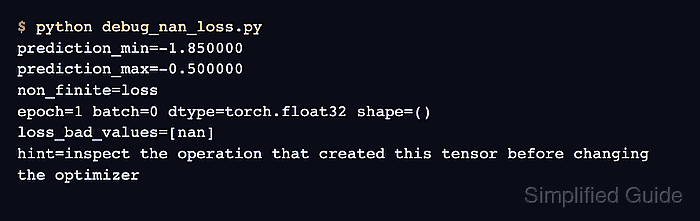
- Run the failing loss path to stop at the first non-finite tensor.
$ python debug_nan_loss.py
prediction_range=-1.850000,-0.500000
non_finite=loss
step=0 shape=() dtype=torch.float32
values=[nan]
- Compare the last finite tensor with the first non-finite report.
The finite negative predictions followed by a non-finite loss identify torch.sqrt(prediction) as the invalid operation. The --fixed branch replaces that expression with nn.functional.mse_loss; a project failure may instead point to a logarithm, division, normalization denominator, mask, input batch, or mixed-precision range.
- Run the corrected path to confirm finite gradients and a completed optimizer step.
$ python debug_nan_loss.py --fixed
prediction_range=-1.850000,-0.500000
gradients=finite
loss=7.008750
optimizer_step=complete
- Remove the temporary debug script after the project training step passes the same finite-value checks.
$ rm debug_nan_loss.py

Mohd Shakir Zakaria is a cloud architect with deep roots in software development and open-source advocacy. Certified in AWS, Red Hat, VMware, ITIL, and Linux, he specializes in designing and managing robust cloud and on-premises infrastructures.


