Model code usually consumes groups of samples even though a PyTorch Dataset returns one sample at a time. A DataLoader supplies the iterable boundary between those two layers by fetching dataset items, collating compatible fields, and yielding mini-batches.
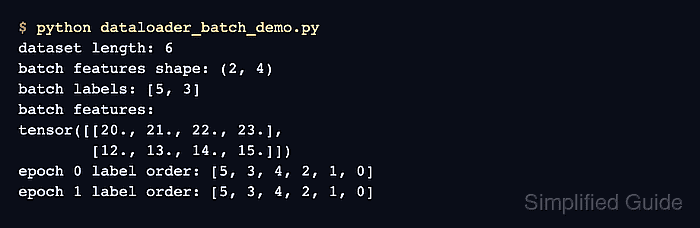
For a map-style dataset such as TensorDataset, the default collate function stacks corresponding fields along a new first dimension. A dataset that returns feature-label pairs therefore produces one feature tensor and one label tensor during each loader iteration.
A seeded torch.Generator makes shuffled sample order reproducible, while num_workers=0 keeps data loading in the main process. Three iterations should cover the six-row sample dataset exactly once and return feature batches whose first dimension equals the requested batch size.
Steps to use a PyTorch DataLoader:
- Create the dataset section in dataloader_batch_demo.py.
- dataloader_batch_demo.py
import torch
from torch.utils.data import DataLoader, TensorDataset


features = torch.arange(24, dtype=torch.float32).reshape(6, 4)
labels = torch.arange(6)
dataset = TensorDataset(features, labels)
- Append a deterministic DataLoader configuration below the dataset.
loader = DataLoader(
    dataset,
    batch_size=2,
    shuffle=True,
    num_workers=0,
    generator=torch.Generator().manual_seed(17),
)
batch_size=2 groups two samples per iteration. shuffle=True randomizes the map-style dataset indexes, and the seeded Generator makes that order repeatable. num_workers=0 fetches samples in the main process.
- Add the batch iteration and coverage output below the loader.
loaded_labels = []

for batch_number, (batch_features, batch_labels) in enumerate(loader, start=1):
    loaded_labels.extend(batch_labels.tolist())
    print(
        f"batch {batch_number}: "
        f"features={tuple(batch_features.shape)} "
        f"labels={batch_labels.tolist()}"
    )

print(f"loaded samples: {len(loaded_labels)}")
print(f"sorted labels: {sorted(loaded_labels)}")
- Run dataloader_batch_demo.py to verify every sample appears in shuffled mini-batches.
$ python3 dataloader_batch_demo.py
batch 1: features=(2, 4) labels=[5, 3]
batch 2: features=(2, 4) labels=[4, 2]
batch 3: features=(2, 4) labels=[1, 0]
loaded samples: 6
sorted labels: [0, 1, 2, 3, 4, 5]

Mohd Shakir Zakaria is a cloud architect with deep roots in software development and open-source advocacy. Certified in AWS, Red Hat, VMware, ITIL, and Linux, he specializes in designing and managing robust cloud and on-premises infrastructures.


