Removing an obsolete table keeps an active MySQL or MariaDB schema easier to maintain, reduces backup and replication churn, and lowers the chance that applications or migration scripts will keep touching data structures that should no longer exist.
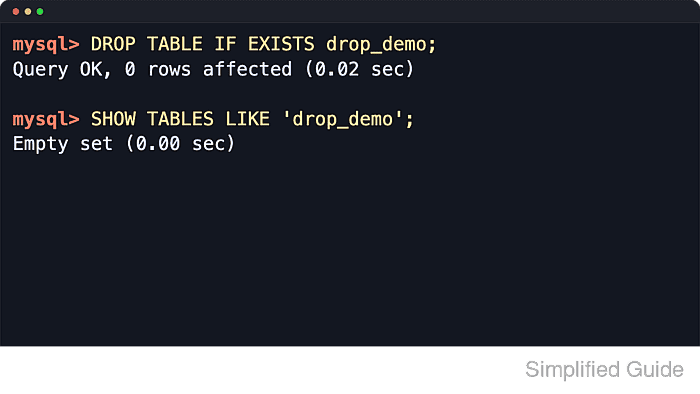
In MySQL and MariaDB, DROP TABLE removes the table definition, rows, indexes, and table triggers in one DDL change. The statement acts on the current database unless the table name is fully qualified, requires the DROP privilege for normal tables, and commits the current transaction unless it is used for a temporary table.
The rollback path is a restore, not a transaction undo, so confirm the exact database and table name, check for foreign-key dependencies, and take a dump before running the drop. MySQL still provides mysql and mysqldump, while current MariaDB installs commonly provide mariadb and mariadb-dump instead. Table-specific grants are not automatically removed with the table, so review obsolete grants if the name should not be reused.
Steps to delete a MySQL or MariaDB table:
- Confirm the exact database and table name before deleting anything.
$ mysql --host=db.example.net --port=3306 --user=dbadmin --password --execute "SHOW TABLES FROM table_demo LIKE 'drop_demo';"
Enter password:
+----------------------------------+
| Tables_in_table_demo (drop_demo) |
+----------------------------------+
| drop_demo                        |
+----------------------------------+
Stop if the query does not show exactly one matching table. On shared servers, the most common destructive mistake is targeting the wrong schema or a similarly named table.
On current MariaDB systems, replace mysql with mariadb when the MySQL compatibility client is not installed.
- Create a logical backup of the table before dropping it.
$ mysqldump --host=db.example.net --port=3306 --user=dbadmin --password --single-transaction --quick table_demo drop_demo > ./drop_demo-before-drop.sql
Enter password:
$ ls -lh ./drop_demo-before-drop.sql
-rw-r--r-- 1 dbadmin dbadmin 2.1K Apr 10 09:18 ./drop_demo-before-drop.sql
Confirm the dump file exists and is non-empty before continuing. The table drop removes both the structure and the data.
On current MariaDB systems, use mariadb-dump instead of mysqldump. MariaDB documents that the old mysqldump name is deprecated and removed from the official Docker image from 11.0 onward.
- Open an interactive SQL client connected to the target database.
$ mysql --host=db.example.net --port=3306 --user=dbadmin --password table_demo
Enter password:
Welcome to the MySQL monitor.  Commands end with ; or \g.
mysql>
Keeping the database name on the command line avoids a later USE against the wrong schema. Use mariadb here when that is the client your host provides.
- Confirm the table is still present and check whether any foreign keys still point at it.
mysql> SHOW TABLES LIKE 'drop_demo';
+----------------------------------+
| Tables_in_table_demo (drop_demo) |
+----------------------------------+
| drop_demo                        |
+----------------------------------+
1 ROW IN SET (0.00 sec)

mysql> SELECT table_schema, TABLE_NAME, constraint_name
    -> FROM information_schema.KEY_COLUMN_USAGE
    -> WHERE referenced_table_schema = DATABASE()
    ->   AND referenced_table_name = 'drop_demo';
Empty SET (0.00 sec)
An empty result from the dependency query means the server catalog has no foreign-key rows pointing at this table in the selected database.
If this query returns rows, stop and remove the dependent foreign key or child table first. A referenced parent table fails before the drop; MySQL 8.4 reports ERROR 3730 and MariaDB 11.4 reports ERROR 1451 for this blocker.
- Drop the table with IF EXISTS so a missing table becomes a warning instead of a hard failure.
mysql> DROP TABLE IF EXISTS drop_demo;
Query OK, 0 ROWS affected (0.02 sec)
DROP TABLE implicitly commits the current transaction on normal tables, so it is not a change that ROLLBACK can undo later. Revoke obsolete table-specific grants separately when the table name should not remain usable.
Use a fully qualified name such as DROP TABLE IF EXISTS table_demo.drop_demo; when the command should not depend on the current database. Wrap identifiers in backticks when they contain reserved words or special characters, for example DROP TABLE IF EXISTS `order`;.
- Verify that the table has disappeared from the database catalog.
mysql> SHOW TABLES LIKE 'drop_demo';
Empty SET (0.00 sec)
If the statement waits instead of returning, another session may still hold a metadata lock on the table. Let the blocking transaction finish, or investigate the waiting session before retrying the drop.
- Exit the client session.
mysql> EXIT;
Bye

Mohd Shakir Zakaria is a cloud architect with deep roots in software development and open-source advocacy. Certified in AWS, Red Hat, VMware, ITIL, and Linux, he specializes in designing and managing robust cloud and on-premises infrastructures.


