Data parallel training keeps identical model weights on several devices while each device processes a different slice of the same global batch. Keras can manage that split through the familiar fit() loop when a DataParallel distribution is active before the model is created.
The keras.distribution implementation currently uses the JAX backend. TensorFlow and PyTorch Keras projects use tf.distribute or DistributedDataParallel instead, so select the JAX backend before the first Keras import for this path.
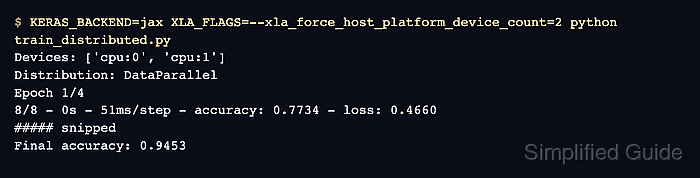
A CPU rehearsal can expose two logical JAX devices through XLA_FLAGS without changing the host configuration. Replace the CPU device selection with gpu or tpu on an accelerator host, remove the CPU-only flag, and keep the global batch size divisible by the number of devices.
Related: How to set the Keras backend
Related: How to install Keras with pip
Steps to run Keras DataParallel training:
- Create the distribution section in train_distributed.py.
- train_distributed.py
import numpy as np

import keras
from keras import layers


keras.utils.set_random_seed(7)

devices = keras.distribution.list_devices("cpu")
if len(devices) < 2:
    raise SystemExit(f"Expected at least 2 CPU devices, found: {devices}")

distribution = keras.distribution.DataParallel(devices=devices)
keras.distribution.set_distribution(distribution)
DataParallel replicates model variables across the listed devices and splits each batch along its first dimension.
- Append the reproducible training arrays after set_distribution(distribution).
rng = np.random.default_rng(7)
x = rng.normal(size=(128, 4)).astype("float32")
y = (x[:, 0] > 0).astype("float32")
- Append the model definition after the target array assignment.
model = keras.Sequential(
    [
        layers.Input(shape=(4,)),
        layers.Dense(1, activation="sigmoid"),
    ]
)
model.compile(
    optimizer=keras.optimizers.SGD(learning_rate=0.2),
    loss="binary_crossentropy",
    metrics=["accuracy"],
)
- Append the training and evaluation block at the end of the compilation section.
model.fit(x, y, epochs=4, batch_size=16, verbose=2)
_, accuracy = model.evaluate(x, y, verbose=0)

if accuracy < 0.85:
    raise RuntimeError(f"Evaluation accuracy below 0.85: {accuracy:.4f}")

print(f"Devices: {devices}")
print(f"Distribution: {type(keras.distribution.distribution()).__name__}")
print(f"Evaluation accuracy: {accuracy:.4f}")
The evaluation uses the trained model on the generated samples and exits with an error when accuracy stays below the stated threshold.
- Review the assembled program as one complete file.
- train_distributed.py
import numpy as np

import keras
from keras import layers


keras.utils.set_random_seed(7)

devices = keras.distribution.list_devices("cpu")
if len(devices) < 2:
    raise SystemExit(f"Expected at least 2 CPU devices, found: {devices}")

distribution = keras.distribution.DataParallel(devices=devices)
keras.distribution.set_distribution(distribution)

rng = np.random.default_rng(7)
x = rng.normal(size=(128, 4)).astype("float32")
y = (x[:, 0] > 0).astype("float32")

model = keras.Sequential(
    [
        layers.Input(shape=(4,)),
        layers.Dense(1, activation="sigmoid"),
    ]
)
model.compile(
    optimizer=keras.optimizers.SGD(learning_rate=0.2),
    loss="binary_crossentropy",
    metrics=["accuracy"],
)

model.fit(x, y, epochs=4, batch_size=16, verbose=2)
_, accuracy = model.evaluate(x, y, verbose=0)

if accuracy < 0.85:
    raise RuntimeError(f"Evaluation accuracy below 0.85: {accuracy:.4f}")

print(f"Devices: {devices}")
print(f"Distribution: {type(keras.distribution.distribution()).__name__}")
print(f"Evaluation accuracy: {accuracy:.4f}")
- Run the completed script to verify DataParallel training across two logical CPU devices.
$ KERAS_BACKEND=jax XLA_FLAGS=--xla_force_host_platform_device_count=2 python train_distributed.py
Epoch 1/4
8/8 - 0s - 51ms/step - accuracy: 0.7734 - loss: 0.4660
Epoch 2/4
8/8 - 0s - 7ms/step - accuracy: 0.8672 - loss: 0.3990
Epoch 3/4
8/8 - 0s - 2ms/step - accuracy: 0.8906 - loss: 0.3547
Epoch 4/4
8/8 - 0s - 8ms/step - accuracy: 0.9453 - loss: 0.3243
Devices: ['cpu:0', 'cpu:1']
Distribution: DataParallel
Evaluation accuracy: 0.9609
Multiple accelerators use gpu or tpu device selection without the CPU-only XLA_FLAGS value.

Mohd Shakir Zakaria is a cloud architect with deep roots in software development and open-source advocacy. Certified in AWS, Red Hat, VMware, ITIL, and Linux, he specializes in designing and managing robust cloud and on-premises infrastructures.


