Red Hat-family systems need a Java runtime before they can launch packaged JAR files, vendor server applications, and other programs that ship Java bytecode instead of native binaries. Installing the distribution OpenJDK runtime gives the host a supported java command managed by DNF and normal operating system updates.
Red Hat packages runtime-only OpenJDK builds as versioned packages such as java-25-openjdk-headless. The headless package is the smaller choice for server and terminal-launched applications, while java-25-openjdk adds desktop Java integration for graphical applications that need it.
The available major version depends on the RHEL, CentOS Stream, or Fedora release and the enabled repositories. Search the repository first, install the runtime package required by the application, and verify java -version before starting the application. A JRE runs existing Java applications but does not install the javac compiler; install the JDK when source compilation is required.
Steps to install Java Runtime Environment (JRE) on Red Hat, CentOS Stream, and Fedora:
- Open a terminal with sudo privileges.
- Search for available OpenJDK runtime packages.
$ dnf search openjdk
##### snipped #####
java-21-openjdk.aarch64 : OpenJDK 21 Runtime Environment
java-21-openjdk-headless.aarch64 : OpenJDK 21 Headless Runtime Environment
java-25-openjdk.aarch64 : OpenJDK 25 Runtime Environment
java-25-openjdk-headless.aarch64 : OpenJDK 25 Headless Runtime Environment
##### snipped #####
The architecture suffix varies by host. Use java-25-openjdk-headless for server and command-line applications, use java-25-openjdk when a desktop Java application needs graphical runtime libraries, and choose an older supported major version only when the application requires it.
- Install the OpenJDK runtime package.
$ sudo dnf install --assumeyes java-25-openjdk-headless
Dependencies resolved.
==========================================================================================
 Package                          Arch     Version             Repository             Size
==========================================================================================
Installing:
 java-25-openjdk-headless         aarch64  1:25.0.3.0.9-1.el9  ubi-9-appstream-rpms   60 M
Installing dependencies:
 alsa-lib                         aarch64  1.2.15.3-1.el9      ubi-9-appstream-rpms  531 k
 java-25-openjdk-crypto-adapter   aarch64  1:25.0.3.0.9-1.el9  ubi-9-appstream-rpms   57 k
 tzdata-java                      noarch   2026b-1.el9         ubi-9-appstream-rpms  230 k
##### snipped #####

Transaction Summary
==========================================================================================
Install  14 Packages

Total download size: 63 M
Installed size: 259 M
##### snipped #####
Complete!
RHEL hosts normally need an enabled AppStream repository and a valid subscription. CentOS Stream and Fedora hosts use their enabled DNF repositories for the same package names.
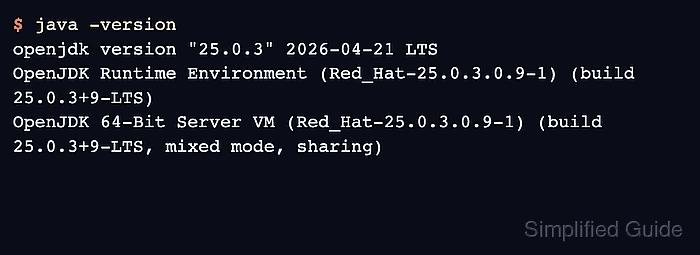
- Verify that the runtime starts.
$ java -version
openjdk version "25.0.3" 2026-04-21 LTS
OpenJDK Runtime Environment (Red_Hat-25.0.3.0.9-1) (build 25.0.3+9-LTS)
OpenJDK 64-Bit Server VM (Red_Hat-25.0.3.0.9-1) (build 25.0.3+9-LTS, mixed mode, sharing)
The exact update number changes as Red Hat, CentOS Stream, or Fedora publishes security updates. The important result is that java runs and reports the OpenJDK major version expected by the application.
- Confirm the installed runtime package if package state needs to be recorded.
$ rpm -q java-25-openjdk-headless
java-25-openjdk-headless-25.0.3.0.9-1.el9.aarch64
- Select the default runtime only when more than one Java runtime is installed.
$ sudo update-alternatives --config java
Choose the path that matches the required major version, then rerun java -version. Red Hat OpenJDK packages can install multiple major versions side by side.

Mohd Shakir Zakaria is a cloud architect with deep roots in software development and open-source advocacy. Certified in AWS, Red Hat, VMware, ITIL, and Linux, he specializes in designing and managing robust cloud and on-premises infrastructures.


