How to run randomized search with scikit-learn
A randomized hyperparameter search trades exhaustive coverage for a fixed number of sampled candidates. That budget is especially useful for continuous SVC parameters such as C and gamma, where a small hand-written grid can overemphasize a few arbitrary values.
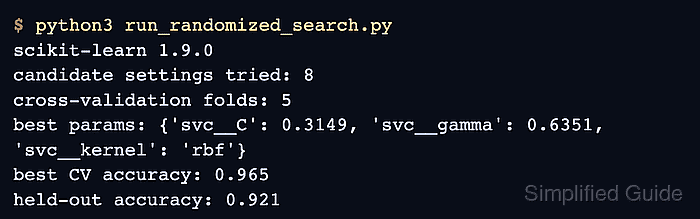
The estimator is a StandardScaler-to-SVC Pipeline, which keeps scaling inside each cross-validation training fold. Log-uniform distributions give each order of magnitude equal sampling weight, while nested parameter names target the classifier without separating it from preprocessing.
A stratified split reserves rows from every search decision. Five shuffled folds rank eight training-set candidates by mean accuracy; only after that ranking is inspected does a separate verifier score the refitted winner against the held-out rows.
Steps to run randomized search with scikit-learn:
- Choose the training boundary and estimator pipeline in run_randomized_search.py.
- run_randomized_search.py
from joblib import dump
from scipy.stats import loguniform
from sklearn.datasets import load_iris
from sklearn.model_selection import RandomizedSearchCV, StratifiedKFold, train_test_split
from sklearn.pipeline import Pipeline
from sklearn.preprocessing import StandardScaler
from sklearn.svm import SVC


X, y = load_iris(return_X_y=True)
X_train, X_test, y_train, y_test = train_test_split(
    X,
    y,
    test_size=0.25,
    stratify=y,
    random_state=42,
)

pipeline = Pipeline(
    [
        ("scaler", StandardScaler()),
        ("svc", SVC()),
    ]
)
The test split stays outside RandomizedSearchCV so it cannot influence candidate selection. Scaling remains inside the pipeline and is fitted separately for each training fold.
- Define log-uniform C and gamma distributions beneath the pipeline.
param_distributions = {
    "svc__C": loguniform(1e-2, 1e2),
    "svc__gamma": loguniform(1e-4, 1e0),
    "svc__kernel": ["rbf"],
}
The svc__ prefix addresses the named classifier step. Each log-uniform range samples across several orders of magnitude without enumerating a fixed grid.
- Configure a five-fold stratified accuracy search with an eight-candidate budget.
cv = StratifiedKFold(
    n_splits=5,
    shuffle=True,
    random_state=42,
)

search = RandomizedSearchCV(
    estimator=pipeline,
    param_distributions=param_distributions,
    n_iter=8,
    scoring="accuracy",
    cv=cv,
    random_state=42,
    refit=True,
)
n_iter=8 bounds the search at eight sampled settings. refit=True fits the selected pipeline again on all training rows after cross-validation.
- Fit the bounded search on the training rows.
search.fit(X_train, y_train)
- Rank every sampled candidate through cv_results_.
results = search.cv_results_
ranked_indices = sorted(
    range(len(results["params"])),
    key=lambda index: results["rank_test_score"][index],
)

print("rank  mean CV accuracy  C         gamma")
for index in ranked_indices:
    params = results["params"][index]
    print(
        f"{results['rank_test_score'][index]:>4}  "
        f"{results['mean_test_score'][index]:>16.3f}  "
        f"{params['svc__C']:>8.4f}  "
        f"{params['svc__gamma']:>8.4f}"
    )
rank_test_score orders candidates by the configured accuracy scorer. Equal mean scores can share the same rank.
- Persist the refitted winner and untouched rows after the ranking loop.
dump(search.best_estimator_, "randomized_search_winner.joblib")
dump((X_test, y_test), "randomized_search_holdout.joblib")
- Run the bounded search to inspect its ordered candidate ranking.
$ python3 run_randomized_search.py
rank  mean CV accuracy  C         gamma
   1             0.965    0.3149    0.6351
   1             0.965    8.4718    0.0248
   1             0.965    2.5378    0.0680
   4             0.911   21.3683    0.0007
   5             0.588    0.0121    0.7579
   6             0.579    0.0171    0.2915
   7             0.570    0.0421    0.0004
   7             0.570    0.0534    0.0005
- Build verify_randomized_winner.py to score the refitted winner against the reserved rows.
- verify_randomized_winner.py
from joblib import load
from sklearn.metrics import accuracy_score
from sklearn.utils.validation import check_is_fitted


winner = load("randomized_search_winner.joblib")
X_test, y_test = load("randomized_search_holdout.joblib")

check_is_fitted(winner)
predictions = winner.predict(X_test)
held_out_accuracy = accuracy_score(y_test, predictions)
required_accuracy = 0.85

if held_out_accuracy < required_accuracy:
    raise SystemExit(
        f"held-out accuracy {held_out_accuracy:.3f} "
        f"is below the required {required_accuracy:.3f}"
    )

print(f"held-out accuracy: {held_out_accuracy:.3f}")
print(f"required accuracy: {required_accuracy:.3f}")
The verifier loads the already-refitted pipeline and predicts rows that were excluded from every candidate fit. The nonzero exit below the declared accuracy floor makes this check fail-capable.
- Run the held-out verifier with the required accuracy floor.
$ python3 verify_randomized_winner.py
held-out accuracy: 0.921
required accuracy: 0.850