How to run grid search with scikit-learn
Hyperparameter search is most useful when the candidate space is small enough to examine completely. GridSearchCV fits every declared combination across cross-validation splits, making the computation predictable and the selected settings traceable.
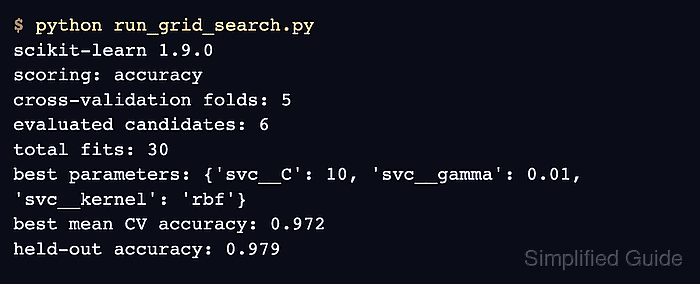
A Pipeline keeps StandardScaler inside each training fold, so the scaler never learns from validation rows. Pipeline parameters use the step name followed by a double underscore, which gives grid keys such as svc__C and svc__gamma.
The breast cancer dataset provides a compact binary-classification run with a separate test split. Cross-validation selects the parameters from the training rows, while the held-out accuracy checks predictions from the refitted pipeline on rows that did not participate in the search.
Steps to run grid search with scikit-learn:
- Create run_grid_search.py with the dataset-loading section.
- run_grid_search.py
import sklearn
from sklearn.datasets import load_breast_cancer
from sklearn.metrics import accuracy_score
from sklearn.model_selection import GridSearchCV, StratifiedKFold, train_test_split
from sklearn.pipeline import make_pipeline
from sklearn.preprocessing import StandardScaler
from sklearn.svm import SVC


X, y = load_breast_cancer(return_X_y=True)

X_train, X_test, y_train, y_test = train_test_split(
    X,
    y,
    test_size=0.25,
    stratify=y,
    random_state=42,
)
The stratified split keeps the class proportions comparable while reserving 25 percent of the rows for the final prediction check.
- Append the model-selection space to run_grid_search.py.
model = make_pipeline(
    StandardScaler(),
    SVC(),
)

param_grid = {
    "svc__C": [0.1, 1, 10],
    "svc__gamma": ["scale", 0.01],
    "svc__kernel": ["rbf"],
}
Three C values multiplied by two gamma values and one kernel produce six candidates. Keeping scaling inside the pipeline fits it separately for every training fold.
- Append the cross-validation search configuration to run_grid_search.py.
cv = StratifiedKFold(
    n_splits=5,
    shuffle=True,
    random_state=42,
)

search = GridSearchCV(
    estimator=model,
    param_grid=param_grid,
    scoring="accuracy",
    cv=cv,
    refit=True,
)
refit=True rebuilds the best pipeline on the complete training split after candidate scoring finishes.
- Append the held-out evaluation section to run_grid_search.py.
search.fit(X_train, y_train)
test_predictions = search.predict(X_test)
held_out_accuracy = accuracy_score(y_test, test_predictions)
candidate_count = len(search.cv_results_["params"])

print(f"scikit-learn: {sklearn.__version__}")
print(f"evaluated candidates: {candidate_count}")
print(f"cross-validation fits: {candidate_count * search.n_splits_}")
print(f"best parameters: {search.best_params_}")
print(f"best mean CV accuracy: {search.best_score_:.3f}")
print(f"held-out accuracy: {held_out_accuracy:.3f}")
- Run run_grid_search.py in the Python environment that contains scikit-learn.
$ python run_grid_search.py
scikit-learn: 1.9.0
evaluated candidates: 6
cross-validation fits: 30
best parameters: {'svc__C': 10, 'svc__gamma': 0.01, 'svc__kernel': 'rbf'}
best mean CV accuracy: 0.972
held-out accuracy: 0.979
Six candidates across five folds produce thirty fits. The final accuracy comes from predictions made by the refitted search object on the held-out rows.