How to use an Anthropic-compatible client with Ollama
Ollama can answer requests shaped like the Anthropic Messages API, which lets tools that expect Anthropic endpoints talk to a local Ollama server. The compatibility layer is useful when an application exposes only Anthropic-style base URL and token settings.
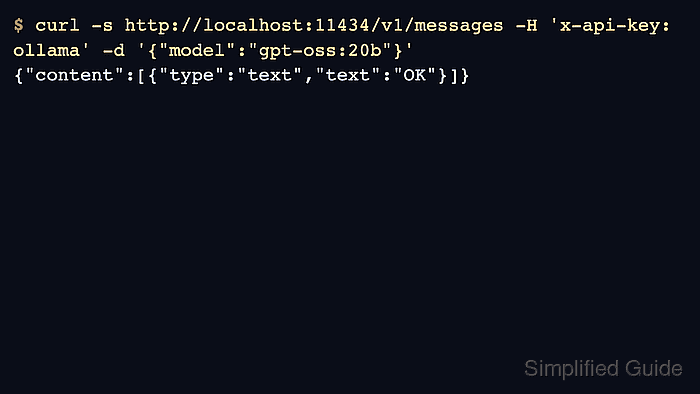
The local server still ignores the placeholder token, but many clients require one syntactically. Point the client at http://localhost:11434 and keep the model name set to an Ollama model that supports the requested behavior.
Compatibility does not make every Anthropic feature identical. Start with a minimal messages request, then add streaming, tools, or longer context after the basic route returns final text.
Steps to use an Anthropic-compatible client with Ollama:
- Set the Anthropic-compatible environment variables for local tools.
$ export ANTHROPIC_AUTH_TOKEN=ollama
$ export ANTHROPIC_BASE_URL=http://localhost:11434
The token value is required by some clients but ignored by the local Ollama server.
- Send a minimal Messages API request.
$ curl -s http://localhost:11434/v1/messages \
  -H 'Content-Type: application/json' \
  -H 'x-api-key: ollama' \
  -H 'anthropic-version: 2023-06-01' \
  -d '{
    "model": "gpt-oss:20b",
    "max_tokens": 80,
    "messages": [{"role":"user","content":"Return only OK."}]
  }'
{"type":"message","content":[{"type":"thinking"},{"type":"text","text":"OK"}],"stop_reason":"end_turn"}
- Read final text from content entries with type text.
$ python3 - <<'PY' content = [{"type":"thinking"}, {"type":"text", "text":"OK"}] print(''.join(part.get('text','') for part in content if part.get('type') == 'text')) PY OK - Increase max_tokens if a thinking model stops before final text.
$ curl -s http://localhost:11434/v1/messages -d '{"model":"gpt-oss:20b","max_tokens":20,"messages":[{"role":"user","content":"Return OK."}]}'
{"content":[{"type":"thinking"}],"stop_reason":"max_tokens"}
For gpt-oss models, too small a token cap can spend the budget on reasoning.
- Run the same client with the application model name after the smoke test passes.
$ export ANTHROPIC_MODEL=gpt-oss:20b
Use the model name from ollama list or api/tags.