How to add LlamaHub tools to a LlamaIndex agent
Agent tool lists often need both packaged service integrations and small application-specific functions. LlamaIndex uses the same tool interface for both sources, so a FunctionAgent can receive them as one ordered collection.
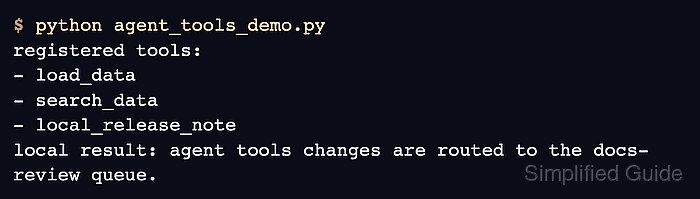
A ToolSpec converts a service integration into individual tools through to_tool_list(). The WikipediaToolSpec used here supplies load_data and search_data, while FunctionTool.from_defaults() converts a typed Python function into local_release_note.
The included MockLLM keeps the registration test independent of an API key because the agent does not choose a tool from a prompt. A production agent needs the application's tool-calling LLM before it can select among these registered tools for user requests.
Steps to add LlamaHub tools to a LlamaIndex FunctionAgent:
- Install LlamaIndex core and the Wikipedia ToolSpec package in the project environment.
$ python -m pip install llama-index-core llama-index-tools-wikipedia
The package name changes to the specific llama-index-tools-* integration for another service. Each integration can add its own credentials and runtime requirements.
- Add the imports and local function to a new agent_tools_demo.py file.
- agent_tools_demo.py
from llama_index.core.agent.workflow import FunctionAgent
from llama_index.core.llms import MockLLM
from llama_index.core.tools import FunctionTool
from llama_index.tools.wikipedia import WikipediaToolSpec


def local_release_note(component: str) -> str:
    """Return the release-note owner for a LlamaIndex component."""
    return f"{component} changes are routed to the docs-review queue."
The type annotation and docstring become part of the schema and description that FunctionTool exposes to the agent.
- Append the packaged and local tool construction to agent_tools_demo.py.
- agent_tools_demo.py
wiki_tools = WikipediaToolSpec().to_tool_list()
local_tool = FunctionTool.from_defaults(local_release_note)
tools = [*wiki_tools, local_tool]
to_tool_list() expands the ToolSpec into separate callable tools before the local tool is added to the same list.
- Append the FunctionAgent configuration to agent_tools_demo.py.
- agent_tools_demo.py
agent = FunctionAgent(
    name="ResearchAgent",
    description="Uses packaged Wikipedia tools and local release-note routing.",
    llm=MockLLM(),
    tools=tools,
    system_prompt="Use tools when a question needs source lookup or routing.",
)
MockLLM is suitable for inspecting registration without credentials, but it does not provide production tool selection.
- Append the smoke-test block to agent_tools_demo.py.
- agent_tools_demo.py
tool_by_name = {tool.metadata.name: tool for tool in agent.tools}
required_names = {"load_data", "search_data", "local_release_note"}
missing_names = required_names - tool_by_name.keys()

if missing_names:
    raise RuntimeError(f"missing tools: {sorted(missing_names)}")

print("registered tools:")
for name in tool_by_name:
    print(f"- {name}")

local_result = tool_by_name["local_release_note"].call(component="agent tools")
print(f"local result: {local_result.raw_output}")
The missing-name check fails before the output when either the packaged tools or local tool was not registered.
- Run agent_tools_demo.py to verify the combined agent tool list.
$ python agent_tools_demo.py
registered tools:
- load_data
- search_data
- local_release_note
local result: agent tools changes are routed to the docs-review queue.
The two Wikipedia names come from WikipediaToolSpec, and the final line comes from calling the local FunctionTool through the agent's registered tools.