How to check llama.cpp server health
Health checks for llama-server answer whether the HTTP process has reached a state where clients can start using it. A listening TCP port can appear before the model is ready, so checking the health response is safer than treating an open socket as readiness.
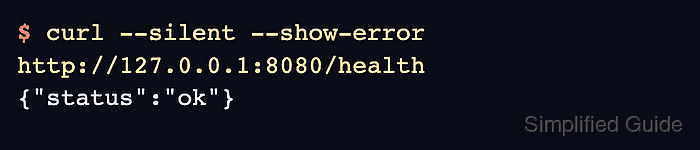
/health returns JSON and does not require an API key. The /v1/health path uses the same check for clients or proxies that route all OpenAI-compatible requests under /v1.
A ready server returns status set to ok with HTTP 200. A loading model returns an unavailable_error response with HTTP 503, and idle-sleep setups need a separate /props check because /health does not wake the model or reset the idle timer.
Related: Start the llama.cpp server
Related: Run llama.cpp with Docker
Related: Call the llama.cpp chat completions API
Steps to check llama.cpp server health:
- Request the default health endpoint.
$ curl --silent --show-error http://127.0.0.1:8080/health
{"status":"ok"}
Replace 127.0.0.1:8080 with the host and port exposed by --host and --port when the server is not using the local default.
- Include the HTTP status code when checking readiness for a monitor or script.
$ curl --silent --show-error --write-out '\nHTTP %{http_code}\n' http://127.0.0.1:8080/health
{"status":"ok"}
HTTP 200
HTTP 200 with status set to ok means the model has loaded and the server is ready for client requests.
- Wait and rerun the check when the model is still loading.
$ curl --silent --show-error --write-out '\nHTTP %{http_code}\n' http://127.0.0.1:8080/health
{"error":{"code":503,"message":"Loading model","type":"unavailable_error"}}
HTTP 503
HTTP 503 is not a successful readiness state. Keep the service running and retry after the startup log reports that the model loaded.
- Check the /v1/health path when the client route uses the OpenAI-compatible prefix.
$ curl --silent --show-error --write-out '\nHTTP %{http_code}\n' http://127.0.0.1:8080/v1/health
{"status":"ok"}
HTTP 200
/v1/health returns the same readiness state as /health.
- Use curl fail mode when the check only needs an exit status.
$ curl --fail --silent --show-error http://127.0.0.1:8080/health
{"status":"ok"}
--fail makes curl exit nonzero for HTTP 503 or other HTTP error responses, which fits container health checks and service monitors that do not need the JSON error body.