How to replay a LangGraph run from a checkpoint
Checkpoint histories turn a completed LangGraph thread into a set of restartable execution boundaries. Replaying from the point before a suspect node isolates that portion of the graph, while a fork lets you change saved state and compare an alternate path without rerunning earlier nodes.
An in-memory checkpointer and deterministic nodes expose replay behavior without a model or credentials. Use a durable checkpointer instead when checkpoint history must survive process restarts.
LangGraph returns the newest checkpoint first from get_state_history(). A snapshot whose next tuple contains write_joke holds the state immediately before that node; invoke(None, checkpoint_config) re-executes downstream nodes, while update_state() creates a branch without changing the original checkpoint.
Steps to replay and fork a LangGraph run from a checkpoint:
- Create replay_checkpoint.py with the state schema and deterministic node functions.
- replay_checkpoint.py
from typing_extensions import NotRequired, TypedDict

from langgraph.checkpoint.memory import InMemorySaver
from langgraph.graph import END, START, StateGraph


class State(TypedDict):
    topic: NotRequired[str]
    joke: NotRequired[str]


def choose_topic(state: State) -> State:
    return {"topic": state.get("topic", "socks")}


def write_joke(state: State) -> State:
    return {"joke": f"A joke about {state['topic']}."}
- Append the graph topology and in-memory checkpointer to replay_checkpoint.py.
- replay_checkpoint.py
builder = StateGraph(State)
builder.add_node("choose_topic", choose_topic)
builder.add_node("write_joke", write_joke)
builder.add_edge(START, "choose_topic")
builder.add_edge("choose_topic", "write_joke")
builder.add_edge("write_joke", END)
graph = builder.compile(checkpointer=InMemorySaver())
- Append the original invocation and checkpoint replay to replay_checkpoint.py.
- replay_checkpoint.py
thread = {"configurable": {"thread_id": "checkpoint-demo"}}
original = graph.invoke({}, thread)

history = list(graph.get_state_history(thread))
before_joke = next(
    snapshot for snapshot in history
    if snapshot.next == ("write_joke",)
)
replayed = graph.invoke(None, before_joke.config)
The next nodes or metadata identify a checkpoint more safely than list position because the history is newest-first and grows as the thread branches.
- Append the checkpoint fork and original-state lookup to replay_checkpoint.py.
- replay_checkpoint.py
fork_config = graph.update_state(before_joke.config, {"topic": "chicken"})
forked = graph.invoke(None, fork_config)
original_checkpoint = graph.get_state(history[0].config)
- Append the output and fail-capable assertions to replay_checkpoint.py.
- replay_checkpoint.py
print(f"checkpoint_next={before_joke.next}")
print(f"original={original}")
print(f"replayed={replayed}")
print(f"forked={forked}")
print(f"original_unchanged={original_checkpoint.values}")

assert replayed == original
assert forked["topic"] == "chicken"
assert forked["joke"] != original["joke"]
assert original_checkpoint.values == original
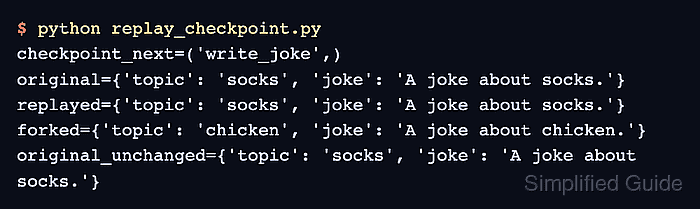
- Verify checkpoint replay and fork preservation with replay_checkpoint.py.
$ python replay_checkpoint.py
checkpoint_next=('write_joke',)
original={'topic': 'socks', 'joke': 'A joke about socks.'}
replayed={'topic': 'socks', 'joke': 'A joke about socks.'}
forked={'topic': 'chicken', 'joke': 'A joke about chicken.'}
original_unchanged={'topic': 'socks', 'joke': 'A joke about socks.'}
The matching replayed value shows downstream execution resumed from the selected checkpoint. The changed forked value and unchanged original snapshot prove that update_state() created a separate branch.